

On this page 24 sections
- Why Communication Is Your Strongest Leadership Tool
- The Real Impact on Your Restaurant Floor
- Four Pillars of Managerial Communication
- Building a Foundation of Active Listening and Clarity
- The Art of Listening to Understand
- Speaking with Clarity to Eliminate Ambiguity
- Putting Clarity into Practice
- Navigating Difficult Conversations with Confidence
- A Framework for Constructive Feedback
- Mediating Conflict Between Team Members
- Addressing Performance Issues with Empathy
- Running Meetings and One-on-Ones That Matter
- The Fifteen-Minute Pre-Shift Huddle
- What to Cover in Your Huddle
- Moving Beyond Updates in One-on-Ones
- Structuring Your One-on-Ones for Impact
- Using Communication to Boost Motivation and Morale
- The Power of Recognition and Praise
- Communicating Change Effectively
- Common Communication Challenges for Managers
- How Can I Connect With Team Members From Different Backgrounds?
- What Are the Best Tools for Team Communication?
- How Do I Give Feedback to a Defensive Employee?
- What Is the First Communication Skill a New Manager Should Master?
Let’s be honest: a chaotic dinner service often boils down to a single miscommunication. This guide is not about "soft skills." It’s a practical playbook for making communication your most powerful operational tool—the one that turns potential chaos into seamless service, night after night.
Why Communication Is Your Strongest Leadership Tool
Effective communication is more than a line on a job description; it’s the engine that drives a successful restaurant. From the host stand to the pass, every single interaction depends on how clearly and consistently you communicate. When messages land, teams are aligned, guests feel seen, and problems get solved before they ever escalate.
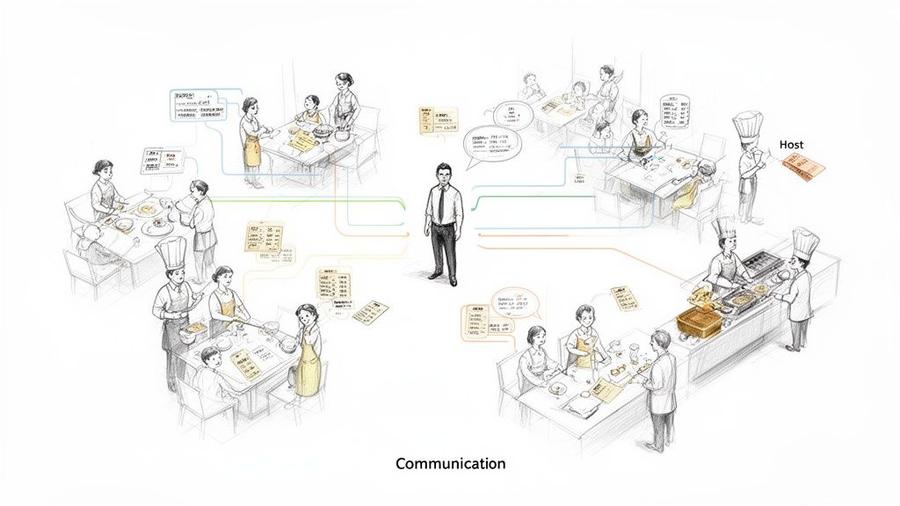
In the high-speed world of hospitality, you’re juggling shift changes, team dynamics, and guest demands all at once. It’s no surprise that communication stands out as the top priority for employers globally.
One survey found that a whopping 57% of global employers see communication as the most critical skill they look for, even more than technical expertise. This means mastering how you speak, listen, and connect with your team directly impacts everything from ticket times and guest satisfaction to employee morale and retention. Think of it as the foundation every other process is built on.
The Real Impact on Your Restaurant Floor
Without a solid communication framework, even the most talented teams will stumble. The fallout is not abstract—it shows up in tangible ways that hit your bottom line and poison your work environment.
Here’s what happens when communication breaks down:
- More Errors and Waste: A misunderstood instruction leads to a wrong order, wasted product, and a comped meal. It’s a direct hit to your profit margin.
- Sinking Employee Morale: When your crew feels unheard or is kept in the dark, frustration builds fast. That confusion creates a toxic atmosphere nobody wants to work in.
- Higher Staff Turnover: A lack of clear feedback, recognition, and genuine connection from leadership is one of the top reasons good people start looking for the door.
- Inconsistent Guest Experience: If the team is not on the same page about service standards or nightly specials, guests get a disjointed and disappointing experience. They might not complain, but they will not come back.
To get this right, you need a strong internal system. We've broken down the four essential pillars every manager needs to master.
Four Pillars of Managerial Communication
This table provides a quick look at the core principles that can immediately improve your team's performance and create a healthier work environment.
Pillar What It Looks Like in Practice Active Listening Not just waiting for your turn to talk. It is about putting your phone down, making eye contact, and asking follow-up questions to show you're actually hearing them. Clarity & Brevity No jargon or rambling. "Table 12 needs waters refilled now" is better than a long explanation. Clear, direct, and to the point. Empathy in Action Acknowledging a server is slammed before asking for one more thing. It’s showing you understand the pressure your team is under. Consistent Feedback Not just during performance reviews. It’s the quick "great job handling that difficult table" after service or the gentle correction in the moment.
Mastering these four areas is the first step toward building a team that trusts you and a restaurant that runs like a well-oiled machine.
To truly make communication your strongest tool, you have to build a strategy around it. Digging into internal communication best practices is the perfect place to start. A solid plan is what allows your team, and your business, to thrive.
Building a Foundation of Active Listening and Clarity
Great communication is not just about what you say. It’s about creating an environment where information flows freely and accurately, even when the floor is pure chaos. For any manager in hospitality, this all starts with two skills: active listening and speaking with absolute clarity.
Mastering these is not about memorizing scripts. It’s about building the trust and efficiency that gets your team through the toughest shifts.
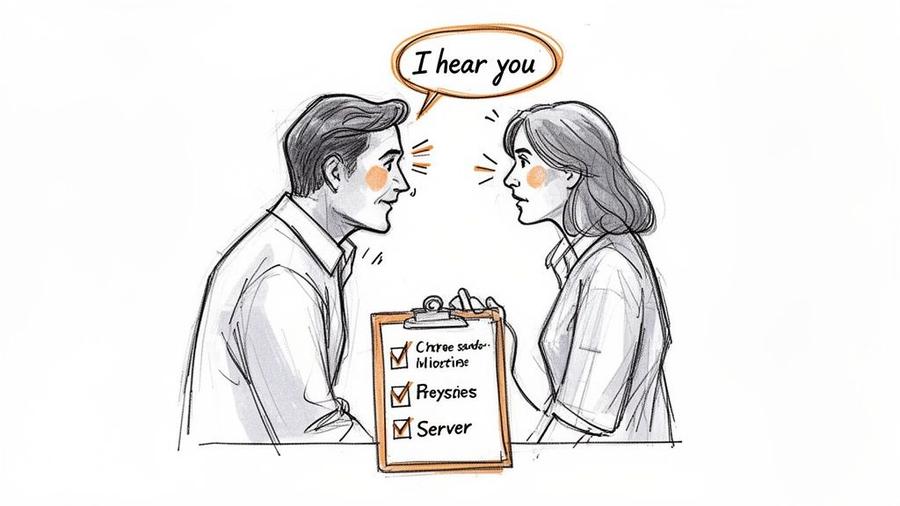
Think about it: botched orders, simmering team conflicts, and service breakdowns can almost always be traced back to a simple miscommunication. It's a bigger deal than you might think. In fact, 30% of employees report feeling frustrated by unclear direction from their managers.
When your team feels like you are not truly hearing them or cannot get a straight answer, morale and performance take a nosedive. This section gives you the tools to make sure that does not happen on your watch.
The Art of Listening to Understand
Active listening is more than just staying quiet while someone else talks. It’s a focused effort to understand the complete message being sent—both the words and the feelings behind them. In a chaotic restaurant, this skill is your best defense against misunderstandings.
Think about the last time a server came to you with a problem during the peak dinner rush. Did you give them your full attention, or was your mind already on the next fire you had to put out? Real listening solves problems faster and builds the kind of rapport that makes people want to work for you.
Here’s how to put active listening into practice on the floor:
- Kill the Distractions. When a team member approaches you, turn away from your screen. Put your phone down. Make eye contact. This simple act shows them they are your priority at that moment.
- Paraphrase and Confirm. After they’ve spoken, repeat their concern back in your own words. Saying, "Okay, so what I’m hearing is Table five is getting antsy about the wait, and you need help getting their drinks out. Is that right?" confirms you understood and gives them a chance to clarify.
- Listen for What Is Not Said. Pay attention to body language and tone. A server who says "I'm fine" with slumped shoulders is telling you a different story. A gentle follow-up like, "You seem a little stressed. What can I do to help?" can make all the difference.
When employees feel their concerns are truly heard, they become more engaged and proactive problem-solvers. The simple act of listening validates their experience and reinforces that you're a team working toward the same goal.
Speaking with Clarity to Eliminate Ambiguity
Just as important as listening is ensuring your own messages land exactly as you intend them. Ambiguity is the enemy of efficiency. Vague instructions lead to mistakes, wasted time, and frustration for everyone.
The goal is to be concise and direct without sounding blunt or dismissive.
For instance, instead of shouting, "Someone needs to take care of that spill," a clear manager says, "Carlos, please grab the mop and clean up the spill by the bar right now." This removes all doubt about who is responsible and when it needs to be done. It’s one of the most vital effective communication skills for managers.
Putting Clarity into Practice
Here are a few common scenarios where clear, direct language can prevent chaos:
Delegating a Task:
- Vague: "We need to get the patio set up for the evening rush."
- Clear: "Maria, I need you to wipe down all the patio tables and set them with silverware. Please have it finished by 4:30 p.m. so we’re ready for the first seating."
Explaining a Policy Change:
- Vague: "Management is making some changes to the side-work policy."
- Clear: "Heads up, everyone. Starting Monday, all closing servers will be responsible for restocking their own station before clocking out. I've posted the new checklist next to the POS system for you to review."
These skills are not just about managing tasks; they're about building a resilient and confident team culture. If you're looking for more ways to strengthen those connections, you can discover valuable insights on how to improve team communication in our detailed guide.
Mastering active listening and clarity ensures every person on your team feels respected, understood, and set up for success.
Navigating Difficult Conversations with Confidence
Some of the most critical moments in management are not during a busy service—they happen during the quiet, uncomfortable conversations. Addressing tardiness, mediating a staff dispute, or delivering constructive feedback can feel like walking on eggshells. But avoiding these talks is a recipe for disaster. Small problems fester and grow into much bigger ones.
Handling these situations with a steady hand is a core part of being a leader. It's about turning a potential conflict into a moment for growth, reinforcing professional standards, and showing your team you’re a manager they can trust.
The key is to reframe them. These are not confrontations; they're collaborative problem-solving sessions. When you have a solid framework, you can navigate these challenges with confidence and actually get a positive outcome for everyone involved.
A Framework for Constructive Feedback
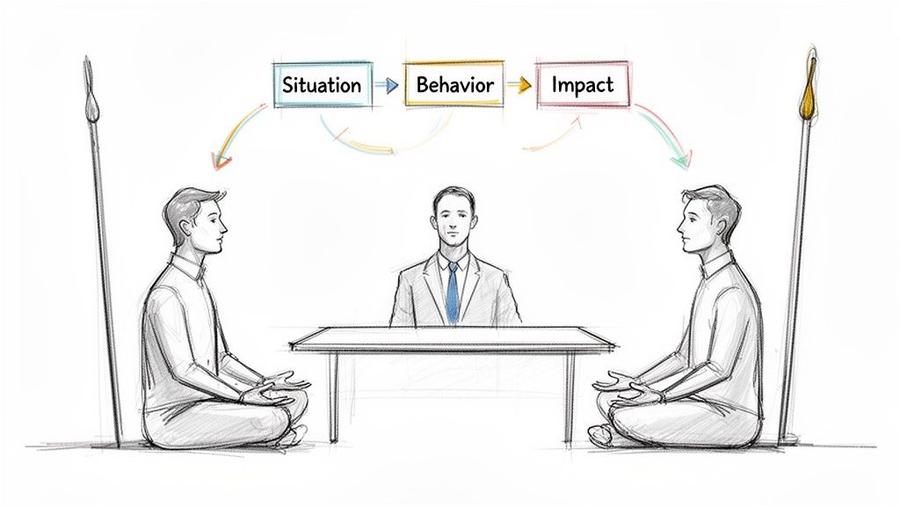
Delivering feedback is an art. Get it wrong, and you can demotivate a great employee. Get it right, and you inspire them to improve because they know you're invested in their career. The Situation-Behavior-Impact (SBI) model is a simple but powerful tool for keeping feedback objective and actionable.
This structure helps strip out personal judgment and focuses the conversation on observable facts, which dramatically lowers the other person's defensiveness.
Here’s how it works:
- Situation: Start by describing the specific context. Set the scene by stating when and where it happened. This grounds the feedback in a real moment.
- Behavior: Describe the exact, observable actions. Avoid interpreting their intent or making assumptions. Stick to what you actually saw or heard.
- Impact: Explain the ripple effect of that behavior. This could be the impact on a guest, another team member, or the shift's operations. This is the "why it matters" step.
Let's say a server has been repeatedly forgetting to mention the daily specials.
Instead of saying, "You need to do a better job remembering the specials," which just feels like an attack, you use SBI:
Situation: "During the lunch rush yesterday, I was standing near table seven when you took their order..."
Behavior: "...and I did not hear you mention the pan-seared salmon special."
Impact: "Because of that, the kitchen prepped extra salmon we did not sell, and we missed a chance to give that guest a great recommendation."
This approach is direct, professional, and focuses on solving a problem, not placing blame. It’s a cornerstone of having effective communication skills for managers in any setting.
Mediating Conflict Between Team Members
When tension sparks between two employees, a manager's role is to be an impartial mediator, not a judge. The goal is not to decide who was "right," but to help both people find a respectful way to work together. Ignoring it is the worst thing you can do—it's a guarantee the problem will escalate.
A structured approach can de-escalate emotions and guide the conversation toward a real resolution.
- Meet Separately First: Talk to each person individually to get their side of the story without interruption. This makes them feel heard and gives you a much clearer picture of what's going on.
- Bring Them Together: Find a private, neutral spot to talk. Set the ground rules from the start: no interrupting, no personal attacks, and the shared goal is to find a solution.
- Facilitate, Do Not Dictate: Your job is to steer the conversation. Encourage them to use "I" statements to express how they feel (e.g., "I feel frustrated when...") instead of accusatory "you" statements ("You always...").
- Focus on the Future: Once both sides have been heard, shift the focus from what happened to what happens next. Ask them, "What's one thing you can each agree to do differently moving forward so you can work together more effectively?"
- Document and Follow Up: Get their agreement on a path forward and make a quick note of it. Check in with both employees a few days later to make sure the agreement is holding and to see if they need more support.
Successfully navigating disputes makes your team more resilient. For a deeper dive into managing team dynamics, our guide on how to handle employee conflicts offers more strategies.
Addressing Performance Issues with Empathy
Conversations about performance—like consistent tardiness or missed side work—require you to be firm but empathetic. Your goal is to correct the behavior while preserving the employee's dignity.
Always start by assuming positive intent. There might be something going on that you're not aware of. Open the conversation with curiosity, not an accusation.
For example, here's how to address an employee who has been consistently late:
- Be Direct and Private: "Hey Alex, got a minute to chat in the office? I noticed you’ve been about 15 minutes late for your last three shifts."
- State the Impact: "When you're late, it puts the opening team behind and delays our floor setup for service."
- Ask, Do Not Assume: "Is there anything going on that I should know about?"
This simple question opens the door for a real conversation. By combining clarity, structure, and genuine empathy, you turn these difficult talks from something you dread into a powerful way to build a stronger, more accountable team.
Running Meetings and One-on-Ones That Matter
Let's be honest: most meetings get a bad rap. They can feel like a frustrating waste of time, pulling you and your team away from the urgent demands of the floor.
But when done right, they are one of the most powerful tools a manager has. A good meeting transforms a dreaded obligation into a high-value touchpoint that actually strengthens the team. The secret is treating every single one—from a quick pre-shift huddle to a formal one-on-one—with purpose.
These are not just moments to pass on information. They are opportunities to set the tone, clarify what matters most, and build the kind of genuine rapport that makes your team resilient when things get tough.
This shift in mindset is crucial because your team notices when their time is respected. Ineffective meetings just add to the feeling of disorganization, and research shows that 30% of employees already feel frustrated by unclear communication from their managers. Purposeful meetings are the direct antidote.
The Fifteen-Minute Pre-Shift Huddle
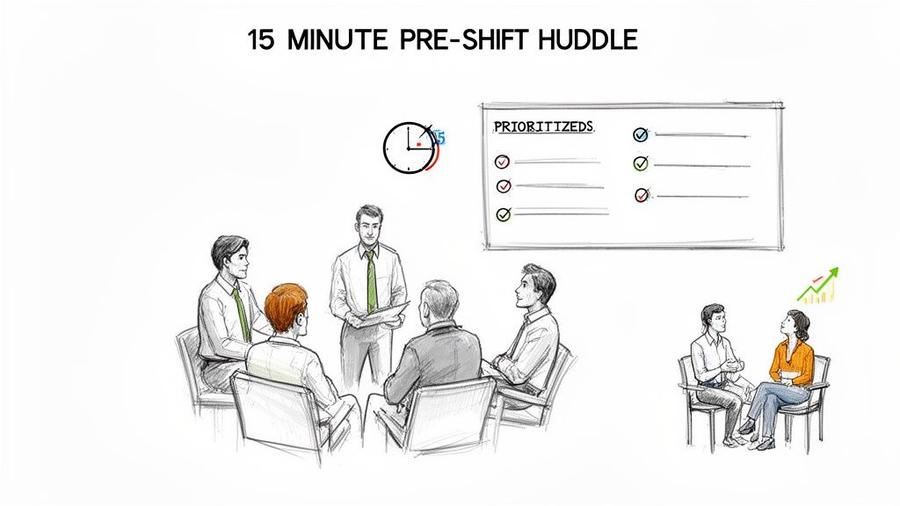
The daily pre-shift huddle is your single best chance to get everyone aligned before service kicks off. It has to be short, energetic, and packed with only the essential information. This is not the time for long-winded speeches; it's a quick, focused briefing to get everyone on the same page.
A great huddle can be broken down into three simple parts:
- Celebrate a Win (two minutes): Always start on a high note. Give a specific shout-out to a person or the team for something great that happened yesterday. “Huge shout-out to Sarah for the way she handled that big party last night. She stayed calm, organized, and the guests left raving about the service.”
- Set the Priorities (10 minutes): This is the core of the meeting. Quickly cover the essentials for the shift ahead. This is where your clarity as a manager really shines.
- Energize and Deploy (three minutes): End with a final shot of motivation. It could be a shared goal for the night or just a confident, "Let's go have a great service." That final moment sets a positive, forward-looking tone.
What to Cover in Your Huddle
To keep the huddle tight and effective, stick to the absolute need-to-knows. This ensures your team is equipped for success without feeling overloaded.
- Key Reservations: "Heads up, we have the Henderson party of 12 coming in at 7:00 p.m. for a birthday. Let's make sure we give them a special experience."
- Daily Specials & 86'd Items: "Tonight's special is the braised short rib. We're already out of the halibut, so please make sure you know your alternative recommendations."
- A Quick Service Tip: "Let's really focus on table resets tonight. The faster we can get tables cleared and ready, the better we can manage the waitlist."
This structure makes sure every pre-shift is a high-impact event that builds momentum for the shift ahead.
Moving Beyond Updates in One-on-Ones
While huddles are for the whole team, one-on-one check-ins are your chance to connect with individuals on a much deeper level. Too often, these meetings become simple status updates on tasks. To make them truly matter, you have to push past the operational stuff and create space for real conversations about career growth, challenges, and well-being.
A great one-on-one is an employee's meeting, not the manager's. Your primary job is to listen, ask thoughtful questions, and understand what your team member needs to be successful and engaged in their role.
Start by shifting the focus from "what are you working on?" to "how are you doing?" That small change can open the door to meaningful discussions about their aspirations and what you can do to support them.
Structuring Your One-on-Ones for Impact
A good one-on-one should feel like a natural conversation, but having a loose structure ensures you cover the important ground. Try dedicating time to three key areas:
- The Present: Start by checking in on their current workload and any immediate roadblocks. Ask questions like, "What's one thing I could do this week to make your job easier?" or "What’s been your biggest win since we last talked?"
- The Future: This is where you talk about career development and show you're invested in their long-term growth. Ask things like, "What skills are you hoping to develop in the next six months?" or "Are there any projects you'd be excited to take on?"
- Your Support: End by reinforcing your role as their advocate. Make it clear you're there to help them succeed. A simple, "How can I better support you?" is a powerful way to close the conversation.
By dedicating time to both team huddles and individual check-ins, you build a powerful communication rhythm. For managers looking to perfect their approach, our guide on how to run effective team meetings provides even more detailed frameworks and tips.
These meetings are more than just calendar entries; they are fundamental to building a team that feels aligned, supported, and ready to deliver outstanding hospitality.
Using Communication to Boost Motivation and Morale
Your words do not just direct workflow; they set the entire tone for your restaurant. The right thing said at the right time can turn a brutal, chaotic shift into a win. It’s what transforms a crew of individual employees into a loyal, motivated team.
Think of proactive, positive communication as the secret ingredient in your culture. It’s what makes people genuinely want to show up and give their best.
When managers drop the ball on communication, the fallout is huge. A shocking 86% of employees and executives point to poor collaboration and communication as the top reason for workplace failures. In a high-pressure kitchen or dining room, that breakdown is even more damaging.
On the flip side, getting it right can slash turnover by 51% and boost retention by 4.5 times. Why? Because it creates a connected, supportive team that has each other's backs. You can review the research on communication in the workplace to see just how deep this connection goes.
The Power of Recognition and Praise
One of the most potent—and most underused—tools in your communication kit is simple recognition. People want to know their hard work is seen and that it matters. When you make a habit of celebrating wins, both big and small, you’re sending a clear message: your contributions are valued here.
This does not have to be some grand, formal affair. In fact, the most powerful recognition is often specific and delivered in the moment.
- Public Praise: A quick shout-out during the pre-shift huddle can be incredibly motivating. "Hey team, big thank you to Marco for coming in early yesterday to help prep when he saw we were slammed. That's the kind of teamwork that makes this place run."
- Private Praise: Pulling someone aside after their shift adds a personal touch that lands with real impact. "Listen, the way you handled that tough customer at table four was masterful. You stayed professional and patient, and you completely turned a bad situation around. Great job."
By actively looking for these moments, you create a positive feedback loop that inspires everyone to bring their A-game. If you need more ideas, check out our guide on employee recognition program ideas.
Communicating Change Effectively
Whether you’re rolling out a new POS system, overhauling the menu, or just changing the scheduling process, any shift in routine can stir up anxiety and resistance. The way you communicate that change is the difference between a smooth transition and a full-blown mutiny.
The single most important thing you can do is explain the why. When your team understands the reasoning behind a decision, they are far more likely to get on board. They see it as a logical step forward, not just another random order from the top.
Do not just announce a new policy. Frame it as a solution to a shared problem. This simple shift makes your team feel like valued partners in the restaurant's success, not just cogs in the machine.
Let's say you're bringing in a new digital checklist for side-work.
The Wrong Way:
"Starting Monday, everyone has to use this new app to sign off on their closing duties. Make sure you do it."
This feels abrupt and controlling. You will get grumbling and, at best, spotty adoption.
The Right Way:
"Team, I know closing can get chaotic, and we've had some tasks fall through the cracks lately. To make it fairer and clearer for everyone, we're going to start using a new checklist app on Monday. This will help us spread the work out evenly and make sure we all know exactly what's expected, so we can all get out of here on time. Let's walk through how it works right now."
By framing the change around the benefit—fairness and getting home sooner—you build understanding and get buy-in. This is how you use your communication skills not just to direct your team, but to motivate and unite them.
Common Communication Challenges for Managers
Even the sharpest managers hit communication roadblocks. The key is not avoiding them—it's knowing what they are and having a plan to navigate them when they pop up. Think of these issues not as personal failures, but as predictable hurdles that come with managing a diverse, high-energy team.
Let's walk through some of the most common scenarios you'll face on the floor and break down what actually works.
How Can I Connect With Team Members From Different Backgrounds?
Building bridges across generational and cultural lines boils down to one thing: genuine curiosity. Your job is not just to manage a diverse crew; it's to lead an inclusive one where every single person feels seen, heard, and respected. That means dropping assumptions and getting interested in different points of view.
Start by listening without jumping to conclusions. Ask open-ended questions like, "Can you walk me through how you see this?" or "What's the best way for us to communicate about schedule changes so it works for you?"
You also have to be mindful of how people prefer to communicate. A younger cook might love a quick update via the team messaging app, while a veteran server might value a quick face-to-face chat. The goal is flexibility. Pay attention to how people respond and adapt your style to meet them where they are—not the other way around. At the end of the day, focusing on shared goals, like crushing service and giving guests an amazing experience, creates a common language that brings everyone together.
What Are the Best Tools for Team Communication?
Nothing will ever replace a real, in-person conversation. But let's be honest, the right tech can be a lifesaver in a busy restaurant. The trick is finding tools that remove friction, not add another complicated step to an already packed day.
Here are a few types of tools that actually move the needle:
- Team Messaging Apps: A dedicated channel is perfect for firing off quick, essential updates—like an 86'd item or a VIP walking in. It keeps work messages out of personal texts and guarantees everyone gets the same info at the same time.
- Modern Scheduling Software: Tools that let your team see schedules, swap shifts, and request time off right from their phones are a game-changer. They kill the endless back-and-forth texts and prevent no-shows.
- Digital Logbooks: When it comes to training updates, new menu items, or policy changes, a simple digital logbook or shared document ensures everyone is working from the most current playbook.
Remember, the best tool is the one your team will actually use. Always prioritize simplicity and mobile-friendly design. If it does not solve a real, daily problem for your crew, it's not worth it.
Keep in mind that clarity in spoken communication is just as vital as the tools you use. For managers looking to refine their spoken communication, dedicated resources exist. Explore how specialized training addresses common challenges faced by leaders, with detailed guidance on Accent Reduction for Managers.
How Do I Give Feedback to a Defensive Employee?
Let's face it, hearing criticism is hard. When an employee gets defensive, it's usually because they feel like they're being attacked. Your first move is to bring the temperature down and shift the conversation from blame to problem-solving.
First, always give tough feedback in private. Calling someone out in public is a fast track to humiliation and defensiveness. When you start the conversation, state your positive intent right away. Make it clear you're on their side and invested in their growth.
Use the Situation-Behavior-Impact (SBI) model to keep the feedback grounded in facts, not feelings. For example: "During the dinner rush yesterday (Situation), I noticed you sighed when that guest asked for a new table (Behavior). That can make our guests feel like they're an inconvenience (Impact)."
After you've laid out the facts, immediately ask for their side of the story. Something as simple as, "Can you tell me what was going on for you in that moment?" opens the door for a real conversation. This approach keeps the focus on the action, not the person, and turns a tense moment into a real coaching opportunity.
What Is the First Communication Skill a New Manager Should Master?
If you're a new manager, you probably feel like you need to master a dozen skills at once. Slow down. The single most important communication skill to nail down first is consistency.
Your team is watching you, and they need to know what to expect. They're looking for stability, especially from a new leader. Be consistent in everything: your presence on the floor, the way you apply standards to everyone (no favorites!), and your daily communication habits.
The easiest way to start building this is with a simple, consistent pre-shift huddle. Every. Single. Day. Use that five minutes to set a positive tone, share key info, and celebrate a small win. It seems small, but this consistent ritual builds trust and proves you're reliable. That's the foundation you will build every other leadership skill on top of.
At MAJC, we understand that great managers are made, not born. Our platform provides the practical tools, expert-led training, and supportive peer community you need to master these communication skills and build a team that thrives. Learn how MAJC can help you hire better, retain longer, and run smarter.