

On this page 23 sections
- Starting with Why Before How
- Identify the Core Problem
- Set Objectives That Drive Business Results
- Designing a Curriculum People Actually Want to Use
- Structure Content for Retention and Impact
- Mix Up Your Content Formats
- Make Your Content Memorable
- Choosing the Right Way to Deliver Your Training
- Comparing Your Delivery Options
- Comparison of Training Delivery Methods
- Building a Blended Strategy That Works
- Getting Your Program Off the Ground and Actually Used
- Run a Pilot Program First
- Nail Your Communication Plan
- Get the Logistics Right
- Measuring What Matters and Proving ROI
- A Framework for Meaningful Measurement
- Gathering the Right Data
- Connecting Training to Business Outcomes
- Your Top Training Questions, Answered
- How Long Should a Training Program Be?
- What’s the Biggest Mistake to Avoid?
- How Do You Keep People from Zoning Out During Training?
Every great training program I have ever built started with a simple framework: first, figure out what you actually need; then, set crystal-clear goals; and finally, decide how you will measure success.
This is not about checking a box. It is about building a program that solves real business problems from day one.
Starting with Why Before How
It is so tempting to jump straight into creating content—designing slides, scheduling workshops, and you know the drill. But that is like building a house without a blueprint. Before you get to the "how," you have to nail down the "why."
This first phase is all about digging into your restaurant's specific challenges to make sure your program is built for impact, not just for show.
This all starts with a training needs analysis. It sounds corporate, but it is really just about getting to the truth. Talk to your people, look at the performance data, and watch what actually happens during a busy service. This is how you find the real skill gaps holding your team back. Are guest satisfaction scores dipping? Are new hires taking forever to get up to speed? Those are just symptoms of a deeper training need.
Identify the Core Problem
The whole point here is to move past assumptions. For instance, you might think the kitchen team needs speed-of-service training, but after a few conversations, you find out the real bottleneck is a disorganized prep station. A program focused on speed would totally miss the mark.
To do this right, you need to gather intel from a few different places:
- Employee Interviews: Just ask your frontline staff. What is their biggest frustration? Where do they feel lost or unsupported? They know the real story.
- Performance Data: Look at the hard numbers. Sales figures, waste reports, and guest feedback do not lie. They will point you straight to the areas that are underperforming.
- Direct Observation: Be a fly on the wall. Spend time on the floor during a crazy dinner rush and see where the system actually breaks down.
The investment in training is massive and only getting bigger. Globally, companies are pouring over $400 billion into workplace training to close skills gaps. And it pays off—brands with solid, in-depth programs see 218% higher income per employee, and 59% of employees say the quality of their training directly impacts how well they do their job. This proves a well-aimed program can deliver a serious return.
Set Objectives That Drive Business Results
Once you understand the "why," it is time to set clear, measurable goals that tie directly to business outcomes. This is the step that turns training from a line-item expense into a strategic investment. Vague goals have no place here. A powerful objective is specific, measurable, and time-bound. It connects the training activity directly to a tangible business result, making it easy to prove the program's value later on.
Instead of a fluffy goal like "improve customer service," get specific: "Reduce customer complaint resolution time by 15% within the next quarter."
Do not just say, "train new servers." Aim for something concrete like, "Decrease new server onboarding time from four weeks to three weeks by the end of Q2."
This flow—analyze needs, set goals, and define impact—is the foundation for everything that comes next.
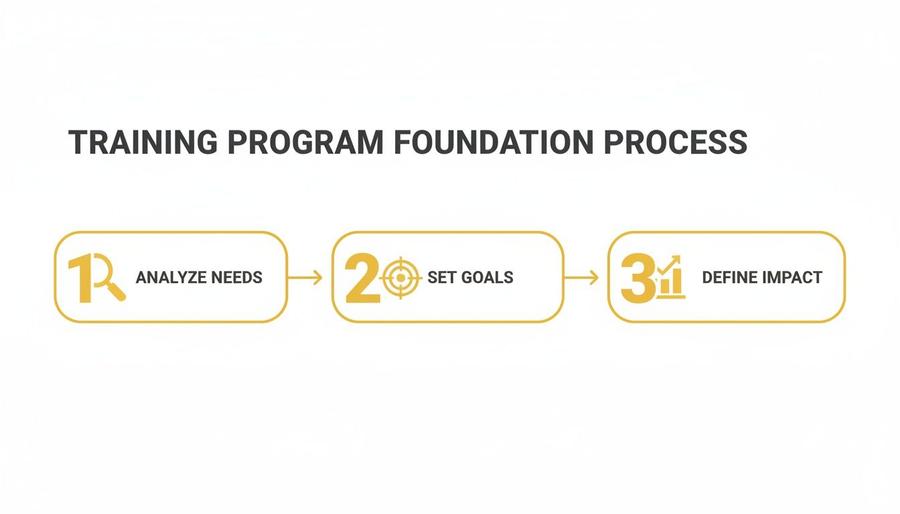
Each step builds on the last, ensuring every training initiative is laser-focused and aligned with what the business actually needs. This approach does not just build skills; it directly impacts team morale and stability. If you are looking for more ways to create a supportive environment, check out our guide on how to improve employee retention.
Designing a Curriculum People Actually Want to Use
Okay, you have got your goals locked in. Now comes the fun part: building a curriculum that actually sticks. This is not about creating some dusty, three-ring binder that ends up propping a door open. The mission is to design a learning experience that your team finds useful, engaging, and even enjoyable.
The best training programs feel like a logical journey, not a random collection of facts. Each piece should build on the last, taking a new hire from foundational knowledge to advanced skills without totally overwhelming them. Think of it like teaching a new cook: you do not start with advanced plating techniques before they have mastered basic knife cuts.
Structure Content for Retention and Impact
The secret to a curriculum people will actually use is breaking down big, complex topics into small, digestible modules. Let's be real, adult learners have short attention spans and even less patience for fluff. They need to see the relevance immediately and be able to apply what they have learned tonight.
When training feels like a practical tool instead of a lecture, engagement shoots way up.
Try organizing your curriculum around specific skills or competencies. For a new server, that path might start with mastering the menu, then move to navigating the POS system, and finally, graduate to handling tough guest situations with grace.
This modular approach just works better. Here is why:
- It is less intimidating. A series of short, focused lessons feels way more achievable than a monolithic, eight-hour training marathon.
- It actually improves retention. Our brains are wired to absorb information in smaller chunks. This prevents cognitive overload and helps new skills actually stick.
- It is flexible. Team members can tackle modules when they have a spare moment, making it way easier to fit training into the chaotic reality of a restaurant schedule.
When you structure the content logically, you are guiding them through a clear path. Every module they complete gives them a little win, building momentum and keeping them motivated for the next step.
Mix Up Your Content Formats
Nobody wants to sit through hours of the same old slide presentation. The most effective training programs blend different formats to keep things fresh and appeal to different learning styles. The goal is not just to transfer information; it is to create a dynamic learning environment. One-size-fits-all training rarely works, so blending learning methods helps reach a wider range of learners.
Think about incorporating a mix of these proven formats:
- Bite-Sized Videos: Perfect for showing, not just telling. Think quick demos on how to properly decant a bottle of wine or execute a new closing procedure.
- Interactive Simulations: Let people practice in a safe, no-stakes environment. A simulation could walk a new host through managing a crazy waitlist without affecting a single real guest.
- Practical Checklists and Job Aids: These are gold for on-the-job application. A simple checklist for setting up the dining room ensures consistency and reinforces your standards every single shift.
- Group Discussions and Role-Playing: Nothing beats these for developing soft skills. Role-playing a difficult customer complaint is far more effective than just talking about it.
This variety does not just keep people awake—it deepens their understanding by hitting the same topic from multiple angles. You want to make learning an active process, not a passive one.
Make Your Content Memorable
Finally, the real magic is turning dry material into memorable content. This is what separates a good program from a great one.
Ditch the corporate jargon and use real-world examples and stories your team can actually relate to. Instead of just listing out food safety rules, tell the story about that one time when following them prevented a total disaster. Relatable scenarios make the information concrete and much easier to recall when the pressure is on.
For those of us in this industry, learning how to handle the unique pace and chaos of service is everything. For more specific strategies on this, our guide on how to train restaurant staff quickly and effectively has a ton of practical tips.
By building a curriculum that is structured, varied, and genuinely relevant, you create a program that employees see as an investment in their success—not just another box to check.
Choosing the Right Way to Deliver Your Training
Even the most incredible training content will completely miss the mark if it is delivered the wrong way. The method you choose is just as critical as the material itself—it shapes how your team actually absorbs and uses what they learn on the floor.
This is not about finding one perfect method. It is about matching your delivery to your team's reality, your operational needs, and your budget. The goal is to build a smart, blended learning system where different methods work together to make key skills stick.
A great framework to guide your thinking here is the 70-20-10 model. It breaks down how people really learn and grow in their roles:
- 70% from on-the-job experience: This is where the real learning happens. It is the daily grind, the unexpected challenges, and the hands-on practice that builds true competence.
- 20% from social learning: Think mentorship, peer feedback, and simply watching and learning from seasoned colleagues. It is the stuff that gets passed down from one shift to the next.
- 10% from formal training: These are your structured materials—the workshops, e-learning modules, and courses you create.
While formal training is just 10% of the picture, it is the foundation that makes the other 90% work. It gives your team the language, standards, and core knowledge they need to practice and grow through experience and interaction.
When you embrace this model, training stops feeling like a one-off event and starts becoming part of your restaurant's culture of growth.
Comparing Your Delivery Options
So, how do you deliver that critical 10%? It comes down to weighing the pros and cons of a few solid methods. The strongest training programs do not just pick one; they blend two or three to create a dynamic experience that hits from all angles.
Let's break down the most common approaches you will see in the industry.
To help you decide what is best for your team, here is a quick comparison of the most common training delivery methods. Each has its place, and often the most powerful programs combine them to cover all the bases.
Comparison of Training Delivery Methods
Method Best For Pros Cons In-Person Workshops Complex skills, team-building, and hands-on practice (e.g., knife skills, wine tasting, and service role-playing). High engagement, immediate feedback, and builds team cohesion. Expensive, difficult to scale, and scheduling can be tough. eLearning Platforms Foundational knowledge, compliance training, and standardized procedures (e.g., food safety, HR policies, and POS systems). Flexible, self-paced, consistent delivery, and easy to track completion. Can feel isolating, and engagement can drop without good design. On-Shift Training Applying skills in a real-world context, shadowing, immediate correction, and reinforcement. Highly relevant, learning by doing, and reinforces standards in the moment. Can be inconsistent, may disrupt service, and relies on trainer's quality. Microlearning Quick refreshers, skill reinforcement, and pre-shift updates (e.g., daily specials, and upselling tips). High retention, mobile-friendly, and fits into the flow of work. Not suitable for complex topics, and works best as a supplement.
Ultimately, the best approach is rarely just one of these. The magic happens when you combine them to support your team at every step of their journey, creating a program that is as dynamic as your restaurant.
Building a Blended Strategy That Works
The real secret sauce is blending these methods into a cohesive strategy. This lets you play to the strengths of each approach while covering its weaknesses. A well-designed blended program does not just teach—it supports employees from their first day to their hundredth.
Here is what that could look like for a new server coming on board:
- eLearning for Foundations: Before even hitting the floor, the new hire completes online modules covering the menu, POS system basics, and your core service standards. This gets the basics out of the way on their own time.
- In-Person for Practice: Next, they join a hands-on workshop to practice taking orders, carrying trays, and navigating tricky guest interactions through role-playing. This is where they build muscle memory.
- On-the-Job for Application: Now it is time to shadow a senior server, applying everything they have learned in a real service with guidance and immediate feedback.
- Microlearning for Reinforcement: In the weeks that follow, they get quick video refreshers and quizzes sent to their phone to keep key skills sharp. A two-minute clip on upselling, for instance, is a perfect piece of content to share during the art of the pre-shift meeting to get everyone focused and ready for service.
This blended cycle feels natural and effective. It meets your team where they are, respects their time, and gives them the right kind of support at exactly the right moment. By thoughtfully picking your delivery methods, you ensure your carefully built curriculum actually lands, drives real change on the floor, and becomes a genuine asset to your business.
Getting Your Program Off the Ground and Actually Used
All the work you have put into designing the curriculum and picking the right delivery methods comes down to this moment: the launch. A great rollout is not just sending an email and hoping people show up. It is a strategic push that can make or break your entire training program.
How you introduce a new initiative sets the tone for everything that follows. Get this right, and you build excitement and show your team this is a real opportunity, not just another mandatory meeting. It transforms training from a top-down chore into a shared goal everyone feels invested in.
Run a Pilot Program First
Before you even think about a full-company rollout, you absolutely have to run a small-scale pilot. Think of it as a dress rehearsal for your training. A pilot means testing everything—your materials, your videos, and your on-shift coaching—with a small, trusted group of employees. This is your only chance to catch awkward phrasing, confusing instructions, or tech glitches before they derail the real thing.
This step is non-negotiable. Why? Because it gives you priceless, real-world feedback.
The pilot group will tell you what is landing and what is falling flat. Their insights let you polish the program so the final version is tight, practical, and ready for prime time.
Here is what a good pilot helps you test:
- Content Clarity: Is the material actually easy to understand and apply on the floor?
- Pacing and Flow: Are you moving too fast? Too slow? Is the energy right?
- Engagement: Are the activities keeping people’s attention, or are they checking their phones?
- Tech Sanity Check: Do all the e-learning links work? Does the video play correctly on a phone?
Gathering this feedback early saves you from a messy, ineffective launch and, just as importantly, shows your team you actually value their input.
Nail Your Communication Plan
Once your program is polished and ready, it is time to tell everyone about it. This is not just about sending schedules; it is about selling the "why." Your team needs to understand what is in it for them, personally. A strong communication plan gets everyone on the same page by clearly connecting the training to their own growth and success.
Start talking about it early and often. Use multiple channels—do not just send one email and call it a day. A multi-touch approach using pre-shift meetings, team messaging apps, and posters in the back-of-house builds anticipation and shows this is a priority.
Your communication should focus on the benefits, not just the features. Instead of saying, "You are required to attend a three-hour workshop," frame it as, "We are investing in your growth with a hands-on session designed to help you earn better tips and handle guest issues with more confidence."
Your plan needs to answer three simple questions for your team:
- Why are we doing this? Explain the problem it solves and how it helps the restaurant succeed.
- What is in it for me? Highlight how new skills will make their jobs easier, help them move up, or improve their take-home pay.
- What should I expect? Detail the format, schedule, and anything they need to do beforehand so they feel prepared.
When people understand the purpose and see the personal value, they show up motivated and ready to learn. That is the mindset you are trying to build.
Get the Logistics Right
With a solid communication plan in place, the final piece is managing the nitty-gritty logistics. A smooth rollout depends on careful coordination of schedules, resources, and people. Dropping the ball here can create frustration and kill your program's credibility before it even starts.
First, get your trainers ready. Whether they are managers, veteran staff, or external facilitators, they need to be experts on the material and crystal-clear on the objectives. A confident, well-prepared trainer makes all the difference.
Next, lock down the scheduling and resources. This means booking rooms or setting up virtual meeting links, making sure all the tech is tested and working, and getting materials out ahead of time. For any on-shift training, it is absolutely critical to schedule enough staff coverage so trainees can actually focus without service falling apart.
Finally, make it incredibly easy for people to show up. Send calendar invites with clear instructions. Send reminders leading up to the sessions. And make sure everyone knows who to contact with questions. These small, practical steps remove friction and show your team you respect their time. By managing these details, you create a seamless launch that builds a positive learning culture from day one.
Measuring What Matters and Proving ROI
A training program is not finished when it launches. In many ways, that is just the beginning. The real work is in proving its worth and making sure it adapts over time. This is where measurement comes in.
Tracking the right metrics is how you move from “we think it is working” to “we know it is working, and here is why.” It is what turns a training budget from an expense into an investment.
The global corporate training market was valued at $361.5 billion in 2023 and is projected to skyrocket to $805.6 billion by 2035. That is a massive amount of money being spent, and leadership teams expect real returns. Especially when you consider that companies with comprehensive training can see 218% higher income per employee. This is exactly why proving ROI cannot be an afterthought—it has to be baked in from day one.
A Framework for Meaningful Measurement
A simple, powerful way to evaluate your program's impact is the Kirkpatrick Model. I have used it for years. It breaks down evaluation into four logical levels, helping you measure everything from gut reactions to bottom-line business results. Think of it as a ladder, with each rung building on the one below it to paint a complete picture.
Here are the four levels:
- Level One Reaction: How did your team feel about the training? Was it engaging? Relevant? Did they hate it? You need to know.
- Level Two Learning: What did they actually learn? Did they pick up the skills, knowledge, and mindset you were aiming for?
- Level Three Behavior: Are they using what they learned on the job? Has their behavior on the floor actually changed?
- Level Four Results: Did those new behaviors lead to tangible outcomes? Did you hit the business targets you set out to achieve?
By looking at all four levels, you get a full story of your program’s impact. It makes it so much easier to see what is working and what needs a rethink.
Gathering the Right Data
To measure across the Kirkpatrick Model, you need to use a mix of tools. Each level calls for a different approach, and combining them is what gives you a story you can actually use. Effective measurement is not about collecting mountains of data; it is about collecting the right data. Focus on metrics that tie directly back to your original training objectives and business goals.
Here is a quick breakdown of how to gather data for each level:
- For Level One (Reaction): Keep it simple. Use post-training surveys and quick feedback forms. Ask your team to rate the content, the trainer, and the overall vibe. Quick, anonymous feedback is gold here.
- For Level Two (Learning): You need a "before and after" snapshot. Use pre- and post-training quizzes, skill demonstrations, or even role-playing scenarios to see what knowledge they actually gained.
- For Level Three (Behavior): This is all about observation. Manager checklists, peer reviews, or even mystery shopper reports are great for seeing if new skills are being used consistently on the floor.
- For Level Four (Results): Time to dive into your business data. This is where you connect the training to the numbers that really matter—sales figures, labor costs, and employee turnover.
Connecting Training to Business Outcomes
This last step is everything when it comes to proving ROI. It is where you draw a direct line from your training efforts to real business results.
When you can walk into a leadership meeting and show that your new service training led to a 10% jump in average check size or a 15% drop in food waste, you are not talking about a cost anymore. You are talking about an investment that is paying for itself.
To do this, you have to track the right business metrics from the very beginning. Compare your key performance indicators (KPIs) from before and after the training to show a clear cause-and-effect relationship. If your goal was to improve table turn times, for example, you would measure that specific data point for a few weeks after the training and see how it stacks up against your baseline.
This feedback loop is what makes a training program sustainable. It validates all your hard work, justifies the budget, and gives you the insights to keep making it better. For a deeper dive into which metrics to monitor, check out our guide on the top restaurant KPIs every restaurant manager should track. By aligning your training with these core business drivers, you create a powerful engine for growth and operational excellence.
Your Top Training Questions, Answered
As you start designing a training program, questions always come up. Here are a few of the most common ones we hear from restaurant leaders and managers, along with some straight talk on what actually works.
How Long Should a Training Program Be?
Honestly, there is no magic number. The right length depends entirely on what you are trying to achieve and how complex the skills are. A quick compliance course might be done in an hour, while a full-blown leadership development program could take months.
The focus should always be on the outcome, not the hours logged. It is way more effective to break things down into smaller, digestible pieces—what some people call microlearning. These shorter modules fit into a busy shift and help people actually remember what they learned. For new hires, framing the first few months around a 30, 60, or 90-day plan is a game-changer. The only way to know if you have got the timing right is to pilot the program. Let a small group run through it and give you honest feedback. Is it too fast? Too slow? They will tell you.
What’s the Biggest Mistake to Avoid?
The single biggest pitfall is creating training that is not tied to a clear business goal. Too often, we build programs because it feels like the right thing to do. But without a specific "why," you cannot measure success or prove any kind of return on your investment.
Before you design a single lesson, ask yourself, "What specific problem are we trying to solve?" Every part of your program—from the content to how you deliver it—should point directly back to that answer. A program without that alignment just wastes everyone's time and money, leaving your team wondering why they are even there.
How Do You Keep People from Zoning Out During Training?
Engagement comes down to two things: relevance and variety.
First, the content has to feel real. It needs to connect directly to their daily jobs and show them a clear path forward in their careers. When people see how the training will make their shift easier or help them get that next promotion, they lean in.
Second, mix it up. Nobody wants to sit through a boring lecture for hours. Blend different formats to keep the energy up.
- Short videos
- Interactive quizzes
- Group discussions and role-playing
- Hands-on, on-the-floor practice
Finally, your managers have to be the champions. When a leader actively reinforces what was taught and models the right behaviors back on the floor, employees see that the training actually matters. That is the stuff that makes the lessons stick long after the official session is over.
Ready to build a training program that retains top talent and drives real results? MAJC combines expert-led training, practical tools, and a vibrant community of hospitality leaders to help you run a smarter, more profitable business. Start building your dream team today.