

On this page 28 sections
- Why Measuring Training Effectiveness Is No Longer Optional
- The Rising Cost of Untracked Training
- Your Roadmap to Meaningful Measurement
- Setting the Stage for Success Before Training Begins
- From Vague Goals to Concrete Objectives
- Selecting the Right Key Performance Indicators
- KPIs for Every Corner of Your Restaurant
- Key Hospitality Training KPIs by Department
- Gathering Meaningful Data Without the Guesswork
- Blending Hard Numbers with Human Insight
- Using Pre- and Post-Training Quizzes
- Manager Observation Checklists in Action
- Asking the Right Survey Questions
- Leveraging the Tech You Already Have
- Turning Your Data Into a Clear ROI Story
- A Simple Formula for Calculating Training ROI
- Identifying Your Total Program Costs
- Quantifying Your Program Benefits
- A Real-World Bartender Training Scenario
- Presenting Your Findings to Stakeholders
- Using Feedback to Continuously Improve Your Training
- Spotting Patterns in Your Data
- Translating Insights Into Action
- Fostering a Culture of Learning
- Answering Your Top Training Measurement Questions
- How Often Should I Measure Training?
- What About Training for Soft Skills?
- My Team Is Small. What's a Simple Way to Start?
Measuring training effectiveness is about connecting the dots between your team's skills, your restaurant's performance, and your bottom line. It’s about defining clear goals before you start, collecting real data on performance changes, and calculating the return on that investment to prove the program was worth it.
When you get this right, training stops feeling like a cost and starts acting like a strategic driver for growth.
Why Measuring Training Effectiveness Is No Longer Optional
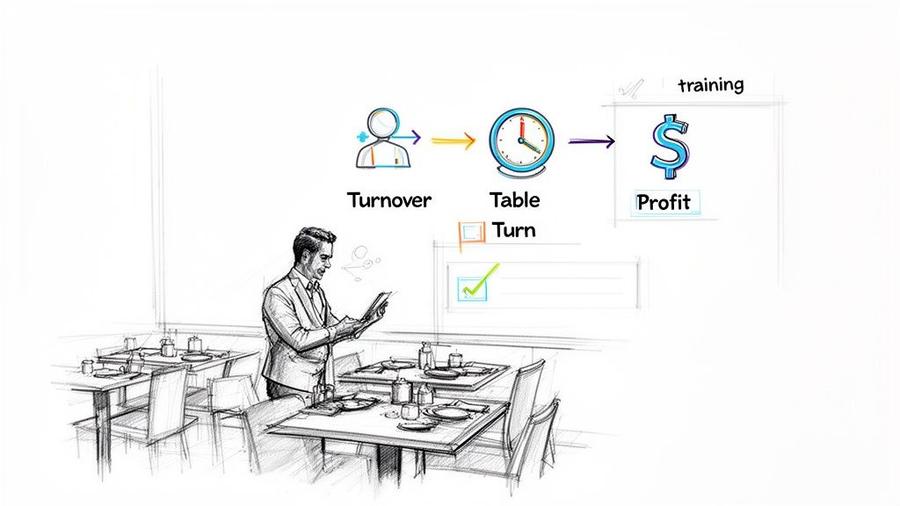
In the restaurant industry, treating training as a simple box-checking exercise is a recipe for failure. Operators are dealing with a tough reality: high employee turnover on one side and even higher customer expectations on the other. Hoping that your training works isn’t a business strategy.
The line between a well-trained, confident team and a healthy bottom line is shorter and more direct than you might think.
This is where understanding how to measure training effectiveness becomes a critical leadership skill. It’s about shifting your perspective from seeing training as an expense to seeing it as a predictable engine for profitability. When you measure, you can manage. You can see what’s working, what isn’t, and where your investment is truly paying off.
The Rising Cost of Untracked Training
The investment in training is significant, and it's growing. Since 2019, the hours your team spends on new hire training have surged. Front-of-house (FOH) hourly staff saw a 57% increase, back-of-house (BOH) a 45% jump, and unit-level managers a 63% growth, now averaging 196 hours.
You can dig into the full hospitality training report for more details on these trends. With this much time and money on the line, leaving the results to chance is a massive financial risk.
Effective measurement is how you justify this investment. It gives you the hard data to show stakeholders that every dollar spent on development comes back in tangible ways:
- Improved Staff Retention: Well-trained employees feel competent and valued, which makes them less likely to leave.
- Enhanced Guest Experience: Confident teams deliver better service, leading directly to higher satisfaction and more repeat business.
- Increased Revenue: Skills like suggestive selling and deep menu knowledge directly boost average check sizes.
- Operational Efficiency: Proper training reduces errors, minimizes waste, and improves table turn times.
Measuring training isn't an HR afterthought; it’s a core business function. It’s the only way to know if your efforts are building a stronger team or just burning through your budget.
Your Roadmap to Meaningful Measurement
This guide is a practical, step-by-step framework designed for busy restaurant operators. We aren't just talking about why you should measure training effectiveness, but exactly how to do it.
You'll get a clear roadmap covering everything from setting sharp, measurable goals before training begins to calculating a clear return on investment (ROI) afterward. We'll show you how to gather meaningful data without guesswork, using tools you probably already have.
By the end, you'll have the skills to turn your training program into a proven asset that consistently drives growth.
Setting the Stage for Success Before Training Begins
Great training results don’t happen by accident—they’re designed. The most important work in measuring training effectiveness begins long before any employee sits down for a session. It all starts with a crystal-clear, strategic vision of what success really looks like for your restaurant.
This is about getting past fuzzy ambitions. Goals like “improve service” or “increase sales” are nice ideas, but they are difficult to measure. To build a program that delivers real, tangible value, you must translate those broad goals into sharp, specific objectives tied directly to business outcomes.
From Vague Goals to Concrete Objectives
The trick is to define exactly what behavior you want to change and how you will put a number on that change. Instead of aiming to "improve service," a stronger objective is to "reduce ticket times for two-top tables by 90 seconds during peak dinner service." That’s a clear target.
Think about the specific skills that drive results in your restaurant. If you want to boost your beverage program's profitability, your training objective isn’t just to “teach the new wine list.” It’s to “increase the average wine-by-the-glass attachment rate from 15% to 20% within 30 days of training completion.”
Getting this specific does two things. First, it forces your training content to be hyper-focused on the skills that move the needle. Second, it gives you a precise benchmark to measure against, so you know without a doubt if the training worked. For more ideas on how this connects to daily operations, check out our guide on how to create standard operating procedures that lock these goals into your workflow.
Selecting the Right Key Performance Indicators
With clear objectives in hand, the next move is picking the right Key Performance Indicators (KPIs) to track your progress. KPIs are the specific, quantifiable data points that tell you whether you’re hitting your targets. In a restaurant, these metrics usually fall into three main buckets: operational, financial, and people.
Choosing the right mix of KPIs is essential for getting the full story on your training's impact. If you only look at one type of metric, you can easily be misled. For example, focusing only on speed (an operational KPI) might accidentally tank the guest experience (a people KPI) or shrink your check averages (a financial KPI).
A balanced approach ensures that improvements in one area don't come at the cost of another. It helps you see how interconnected your whole operation is, and how one smart training session can send positive ripples across the entire business.
According to a study by Gallup, organizations that strategically commit to employee development are not only twice as likely to retain their employees but are also 11% more profitable. That connection starts by tracking the right data from day one.
KPIs for Every Corner of Your Restaurant
Different roles need different metrics. The KPIs for your kitchen crew will naturally be different from those for your front-of-house team. The goal is to pick indicators that directly reflect the core duties and desired results for each specific position.
A well-designed measurement plan connects every training module to a tangible KPI. This framework makes it simple to see which initiatives are driving results and which ones might need a rethink.
To give you a clearer picture, here’s a breakdown of how you can organize KPIs by department to build a solid measurement strategy.
Key Hospitality Training KPIs by Department
By laying this groundwork before a single training session starts, you build a system where success isn't just an opinion—it's a verifiable fact. Every piece of training has a purpose, every outcome can be measured, and every dollar you invest can be traced back to a real improvement in your restaurant's performance.
Gathering Meaningful Data Without the Guesswork
With your training objectives locked in, it’s time to figure out how to prove the training is working. This is where we move from the whiteboard to the floor. The goal is to collect solid evidence without burying your managers in paperwork.
The single most important step is to measure performance before the training starts. This gives you a baseline. Without that starting point, you’re just guessing how much your team has improved. A pre-training assessment provides that crucial "before" picture, making the "after" picture meaningful.
This initial data is the foundation for everything that follows. Think of it as a simple, direct line connecting what you want to achieve with how you'll prove you did it.
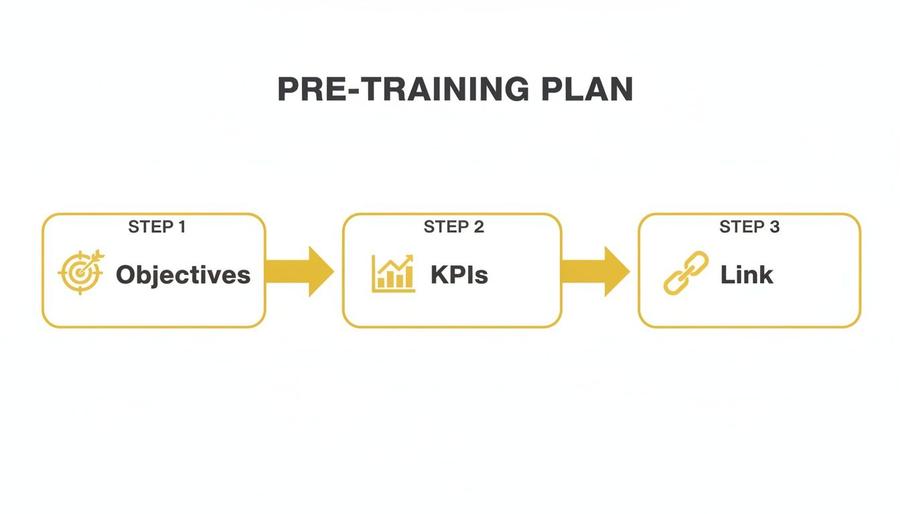
As you can see, every piece of data you collect should tie directly back to the KPIs and objectives you set from the beginning.
Blending Hard Numbers with Human Insight
The best measurement strategies tell a complete story. To do that, you need a mix of hard numbers (quantitative data) and human feedback (qualitative data). Relying on just one gives you a blurry, incomplete picture of your training's real impact.
For instance, your data might show a server’s upsell rate on featured wines jumped by 10%. That’s a great number. But qualitative feedback from a manager’s observation might reveal why—the server is now confidently explaining the wine pairings, not just rattling off a list.
Together, that's a powerful story.
Using Pre- and Post-Training Quizzes
One of the simplest, most effective tools for measuring knowledge gain is a straightforward quiz. The idea isn't to stress your team out, but to get a clean, clear measurement of what they learned.
Before the training, give your team a short quiz on the key topics. After the training wraps up, give them the exact same quiz. The difference in their scores is a direct, undeniable measure of what stuck.
Keep quizzes focused and brief. Ten multiple-choice questions are often more than enough to see if your team grasps the core concepts. This is about measurement, not a final exam.
Manager Observation Checklists in Action
Quizzes tell you what your team knows. Observation checklists tell you what they do. This is where you see if new skills are actually being used during a busy service.
A good checklist breaks a complex skill into small, concrete, observable behaviors. For a server fresh out of suggestive selling training, a manager’s checklist might look like this:
- Did the server mention the daily special without being prompted?
- Did they recommend a specific appetizer or drink to go with an entrée?
- Did they successfully describe a dessert to a table instead of just dropping the menu?
These checklists turn a subjective observation into measurable data and provide a framework for consistent feedback. This approach is fundamental for tracking the top restaurant KPIs that actually move the needle.
Asking the Right Survey Questions
Surveys are your direct line into your team's confidence and perception of the training. While it’s nice to know if they enjoyed it, effective questions dig deeper to see how prepared they feel to use their new skills.
Get away from generic questions like, "Did you find the training helpful?" Instead, ask specific, action-oriented questions that connect directly to your original objectives.
Examples of Better Survey Questions:
- On a scale of 1–5, how confident are you now in handling a guest’s allergy concerns?
- What is one technique from the knife skills training you plan to use during prep tomorrow?
- After the de-escalation training, what’s the biggest change you’ll make when a guest is unhappy?
Questions like these give you real insight into how the training shifted both skills and mindset.
Leveraging the Tech You Already Have
Don't forget the data-gathering powerhouse you already own: your Point of Sale (POS) system. It’s a goldmine of objective information.
When looking at different systems, a Tackon Table vs Clover POS comparison can highlight how different platforms provide the operational metrics you need. You can pull reports to track a server’s upsell performance on specific items from a menu training, monitor ticket times after a kitchen efficiency session, or analyze high-margin cocktail sales after a bartender workshop.
This is the hard, objective proof that your training is translating into tangible results on the P&L.
Turning Your Data Into a Clear ROI Story
You’ve set clear goals, picked your KPIs, and gathered a mix of hard numbers and human feedback. Now for the most important part: connecting the dots. It’s time to make those numbers talk and translate your data into a compelling Return on Investment (ROI) story.
This is where you show the real, tangible value of your training programs. Calculating ROI takes training out of the "cost center" column and puts it squarely in the "business driver" column. It’s the clear, financial proof that leadership needs to see. This isn't just about crunching numbers; it’s about building a powerful case for why investing in your team is one of the smartest things you can do.
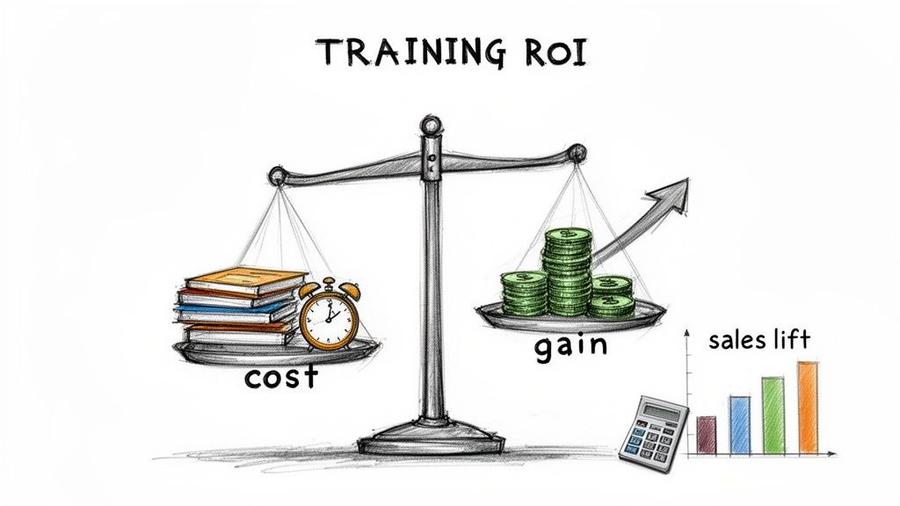
This final step is what separates good programs from great ones. It’s the proof that your investment in people pays real dividends.
A Simple Formula for Calculating Training ROI
Calculating ROI can sound intimidating, but the concept itself is straightforward. You’re just comparing the money you gained from the training to what it cost to run it.
The basic formula looks like this:
ROI (%) = (Net Program Benefits / Total Program Costs) x 100
To get there, you need a firm handle on both sides of that equation. That means digging into every expense and every measurable gain.
Identifying Your Total Program Costs
First, let’s tally every single cost tied to the training program. You have to be thorough here to get an accurate number. For restaurants, common costs usually fall into a few buckets:
- Instructor Costs: This could be the salary of your in-house trainer for the time they spent on the program, or it might be the flat fee for an external consultant.
- Participant Wages: This is a big one people miss. You must account for the wages you paid your team while they were in training and not on the floor or in the kitchen. For a deeper dive, check out our guide on how to calculate labor cost percentage to nail these numbers.
- Materials and Supplies: Think printed handouts, workbooks, any food or beverage items used for tastings or practice, and any other physical materials you needed.
- Technology and Facilities: Did you use a specific software, rent a space, or use any dedicated equipment? Those costs belong here, too.
Add all that up, and you’ve got your "Total Program Costs." That’s the full investment you made.
Quantifying Your Program Benefits
Next, you need to put a dollar value on the positive results the training created. This is where those KPIs you’ve been tracking come into play. Your job is to convert the improvements in those metrics into actual money.
For example, if a training on suggestive selling bumped up the average check size by $2.50, you can calculate the total financial gain based on the number of transactions those trained employees handled over a few weeks. Or, if a kitchen efficiency training cut your food waste by 3%, you can calculate the savings based on your food cost reports.
The key is to isolate the impact of the training as much as possible. Of course, other factors might be at play, but a strong correlation between the training and the improved metric is often more than enough to build a convincing case.
A Real-World Bartender Training Scenario
Let’s walk through a realistic example to see this in action. Imagine your restaurant invested in a new craft cocktail training program for five of your bartenders.
Total Program Costs:
- Trainer Fee: You hired a local mixology expert for a one-day workshop. That cost $1,000.
- Participant Wages: Your five bartenders attended the six-hour training. At an average wage of $15 per hour, this comes out to (5 bartenders x 6 hours x $15/hour) = $450.
- Materials Cost: The liquor, fresh ingredients, and glassware used for practice added up to $300.
- Total Cost: $1,000 + $450 + $300 = $1,750
Program Benefits:
Your goal was to sell more high-margin signature cocktails. Before the training, your team sold about 100 of these cocktails a week. After the training, that number jumped to 150 per week—a nice increase of 50 cocktails.
- Each signature cocktail has a profit margin of $8.
- The weekly increase in profit is (50 cocktails x $8 profit) = $400.
- Over one month (four weeks), the total net benefit is ($400 x 4) = $1,600.
Now, let's plug that into our formula to get the ROI for the first month:
ROI (%) = (($1,600 Net Benefit / $1,750 Total Cost) x 100) = 91.4%
In the first month alone, you’ve made back over 91% of what you spent. That’s a powerful number.
Presenting Your Findings to Stakeholders
When you share your ROI story, don't just throw the final percentage at your stakeholders. Walk them through it. Start with the clear objectives you set, show them the data you collected, and then break down exactly how you calculated the costs and benefits.
Don’t forget to mix your quantitative data with qualitative flavor. Share a quote from a manager’s observation checklist about a bartender’s new confidence, or pull a line from a guest review praising the new cocktail menu. This blend of hard numbers and human stories creates a complete picture of success. It doesn’t just justify what you’ve already spent—it makes a rock-solid case for future investments in your team.
Using Feedback to Continuously Improve Your Training
Measuring training effectiveness isn't a one-and-done deal with a final report card. Think of it as the start of a conversation. The data you've carefully collected is the fuel for a continuous improvement loop, turning good training programs into great ones.
This is where you shift from just knowing the results to understanding what they mean and what to do next. It’s all about spotting patterns, listening to your team, and making smart, small changes that build a stronger, more skilled crew over time.
Spotting Patterns in Your Data
Your data tells a story, but only if you know how to read it. Start by looking for trends and outliers in the quizzes, on-the-floor observations, and performance metrics you've gathered. Don't just glance at the big picture; you have to drill down to find the real insights.
For instance, maybe you notice that four of your new servers consistently failed the wine pairing section of their post-training quiz. That’s a signal. It doesn't mean the servers failed; it means that specific piece of your training has a hole in it. Maybe the content was clunky, the delivery was uninspired, or there just wasn't enough hands-on practice.
The goal isn't to assign blame. It's to find opportunities where a small tweak to your training can unlock a big improvement in your team's performance.
This same logic applies to all your data. A sudden dip in order accuracy rates on Tuesdays might point to a pre-shift communication breakdown, not a training failure. Consistently high marks on a survey about a specific trainer? That tells you who your best mentors are and who should be helping develop the next round of training.
Translating Insights Into Action
Once you spot a pattern, the next step is using it to refine your training. True continuous improvement happens when you create a solid feedback loop. This means closing the feedback loop so data actually turns into progress, not just another report.
Based on what your data is telling you, your next move could be one of several things.
- Tweak a Training Module: If quiz scores point to a specific knowledge gap, like the wine pairing example, go back to that section. You might need to add more visual aids, simplify the language, or turn it into an interactive tasting session.
- Add More Hands-On Practice: Sometimes, knowing isn't the same as doing. If manager observations show a new skill isn't being used on the floor, it’s a sign your team needs more role-playing or live practice before they feel confident.
- Provide Better Post-Training Support: Learning doesn't stop when the session ends. Your feedback might reveal that staff need better job aids, like a quick-reference guide for the POS system or a cheat sheet for common guest questions by the service station.
- Offer Individual Coaching: Sometimes a trend is just a few individuals struggling with a concept. In these cases, a one-on-one coaching session with a manager or a top-performing peer is more effective than re-training the whole team.
Effective feedback is a two-way street. To help your managers deliver insights that build skills and confidence, check out our article on how to give constructive feedback.
Fostering a Culture of Learning
Ultimately, the most powerful way to drive continuous improvement is to make it part of your restaurant's DNA. This starts with how you share the results of your training measurements.
Don't keep the wins a secret. When you see a measurable improvement, celebrate it. Announce in a team meeting that the kitchen's ticket times have dropped by an average of 30 seconds since the new workflow training. Post a chart showing how customer satisfaction scores for service have climbed week over week.
Sharing these positive results does a few critical things:
- It reinforces the value of training in everyone's mind.
- It recognizes the team's hard work and makes them feel invested.
- It builds momentum and makes staff more enthusiastic about the next learning opportunity.
When your team sees that their effort in training leads to real, positive outcomes—for the business and for them—they become active partners in their own development. This creates a powerful cycle where everyone is invested in learning, growing, and making the entire operation better, one shift at a time.
Answering Your Top Training Measurement Questions
Even with a solid plan, real-world questions always pop up. Once you start putting a measurement framework into action, you'll inevitably hit a few roadblocks. Let's tackle some of the most common challenges operators face, so you can get quick answers and keep moving.
How Often Should I Measure Training?
The short answer? Often, and at different times. Good measurement isn’t a one-and-done event. It's a process that reveals different insights at different stages.
- Immediately After: Get those post-training quizzes and satisfaction surveys out within a day or two. You want to capture gut reactions and see if the core knowledge stuck while it's all still fresh.
- 1 to 3 Months Later: This is the magic window for tracking real behavior change. Are they actually doing the things you taught them? Use manager observation checklists and look at performance KPIs to see if new skills are showing up on the floor.
- 6 to 12 Months Later: Now it's time to look at the big picture. This is where you connect the dots between the training and sustained business results like staff retention, customer satisfaction scores, and overall profitability. This tells you if the training had lasting value.
What About Training for Soft Skills?
This is a big one. Measuring "soft skills" like communication, teamwork, or leadership can feel like trying to nail Jell-O to a wall. But it’s totally doable.
The trick is to stop trying to measure a vague concept and start tracking specific, observable behaviors.
Instead of asking, "Did they communicate better?" ask, "Did the manager use active listening techniques in the pre-shift meeting?" or "Did the server successfully de-escalate that customer complaint using the new framework?"
You can put these concrete actions right onto an observation checklist. Suddenly, a subjective skill becomes objective, measurable data.
A study from the University of Michigan found that soft skills training can deliver an impressive 256% return on investment, highlighting its clear link to productivity and team effectiveness. You can track this by focusing on observable behaviors.
My Team Is Small. What's a Simple Way to Start?
If you're running a small shop, the idea of a complex measurement plan can feel overwhelming. Don't let perfection be the enemy of progress.
Pick one high-impact training initiative and focus on just one or two key metrics. That’s it.
Let's say you're training your small front-of-house team on suggestive selling. Your entire measurement plan could be this simple:
- Get a Baseline: Track your average check size for one week before the training.
- Do the Training: Keep it focused, practical, and quick.
- Measure the Change: Track the average check size for two weeks after the training.
This simple before-and-after gives you a clean, powerful data point without needing complicated systems. Once you get comfortable with that rhythm, you can start layering in other things like short surveys or quick observation notes. The goal is just to start.
Ready to build a team that’s not just trained, but truly effective? MAJC provides the tools, community, and expert-led training you need to turn your staff into a high-performing asset. Explore how MAJC can help you hire better and run smarter.