

On this page 28 sections
- What a Restaurant Job Placement Agency Actually Does
- The Core Functions of an Agency
- From Shortlist to Hire
- Understanding the True Cost of Hiring an Agency
- Deconstructing Common Pricing Models
- Agency Fee Structures at a Glance
- Calculating Your Return on Investment
- The Pros and Cons for Restaurants and Job Seekers
- Advantages for Restaurants
- Drawbacks for Restaurants
- Advantages for Job Seekers
- Drawbacks for Job Seekers
- How to Choose the Right Agency for Your Restaurant
- Key Criteria for Your Evaluation
- Essential Questions to Ask Potential Agencies
- Red Flags to Watch For
- Exploring Modern Alternatives to Traditional Agencies
- The In-House Recruiting Approach
- The Rise of Modern Hiring Platforms
- A New Way to Build Your Team
- Comparing Your Hiring Options
- What’s Happening in Hospitality Staffing Right Now?
- A Market That’s Exploding
- How These Trends Affect Your Hiring Game
- Questions We Hear All the Time
- How Long Does It Really Take to Fill a Position?
- Are Agency Fees Set in Stone?
- What Happens If the New Hire Is a Bust?
Think of a restaurant job placement agency as a dedicated matchmaker for the hospitality industry. They connect talented people with restaurants that need their specific skills. Instead of you sifting through endless applications, these specialized agencies find, screen, and present a shortlist of vetted professionals. The goal? To save you a massive amount of time and energy.
What a Restaurant Job Placement Agency Actually Does
A restaurant job placement agency is a specialized talent scout for your business. Just like a scout knows what to look for in a star athlete, these recruiters live and breathe the unique demands of the hospitality world. Their main job is to take the heavy lifting of hiring off your plate so you can get back to running your restaurant.
This process starts way before a candidate ever lands in your inbox. The agency invests a ton of time building a deep network of talented professionals, from executive chefs and GMs to solid line cooks and servers. A huge part of their job is just knowing how to source candidates in a market that is always changing.
The Core Functions of an Agency
Once they find potential candidates, the real work begins. The agency acts as a tough filter, making sure only the people who are the right fit get presented to you. This usually involves a few key steps:
- Initial Screening: First, they go through resumes and applications to match skills and experience with what the job requires.
- In-Depth Interviews: Then they conduct detailed interviews to get a feel for not just technical skills, but also personality, work ethic, and whether they will vibe with your team.
- Skills Verification: For kitchen roles, this could mean practical cooking tests or deep-dive questions about technique and menu ideas.
- Reference Checks: They call previous employers to confirm work history and performance. This is a crucial step that provides a serious layer of security.
By the time a candidate is recommended to you, they have already been through multiple layers of vetting. This means you only meet people who are highly qualified, genuinely interested, and ready to contribute from day one.
From Shortlist to Hire
After all that thorough vetting, the agency hands you a curated shortlist of their top contenders. They give you detailed summaries of each person's strengths and background, which makes your final decision much easier.
They also handle all the annoying logistics, like scheduling interviews and keeping candidates in the loop, which keeps the whole process from stalling. While they manage the admin, you can look for other ways to sharpen your operations. For example, check out our guide on the top restaurant apps that can help with other parts of your business.
At the end of the day, a good agency acts as your expert hiring partner, dedicated to building the skilled and reliable team your restaurant needs to succeed.
Understanding the True Cost of Hiring an Agency
Let's talk money. When you think about using a restaurant job placement agency, the fees are a big part of the conversation. But looking at the upfront cost is only half the story. To get the real financial picture, you have to weigh that fee against all the hidden expenses of hiring on your own.
It is not just about the check you write to the agency; it is about the total value you get back in time, sanity, and a quality hire.
Agency fees are not a one-size-fits-all deal. They usually break down into a couple of common models, depending on whether you need a permanent leader for your team or some temporary help to get through a busy season.
Deconstructing Common Pricing Models
For permanent hires, the go-to model is the contingency fee. This is a straightforward arrangement: you only pay the agency after they find a candidate you love and officially bring them on board. No hire, no fee.
This fee is almost always a percentage of the employee's first-year salary. For most roles in the restaurant world, you can expect this to be somewhere between 20% and 28%.
For temporary or contract staff—think covering a leave of absence or beefing up for the holidays—agencies use a markup rate. This is an all-in hourly rate that covers the employee's wages plus the agency's cut for handling the sourcing, payroll, and all the admin that goes with it. You are basically paying for a flexible, on-demand workforce without any long-term strings attached.
With a contingency model, all the risk is on the agency. You do not pay a dime until the right person is ready to start, which means their success is tied directly to yours.
This infographic breaks down the journey an agency takes to find, vet, and place the right talent in your restaurant.
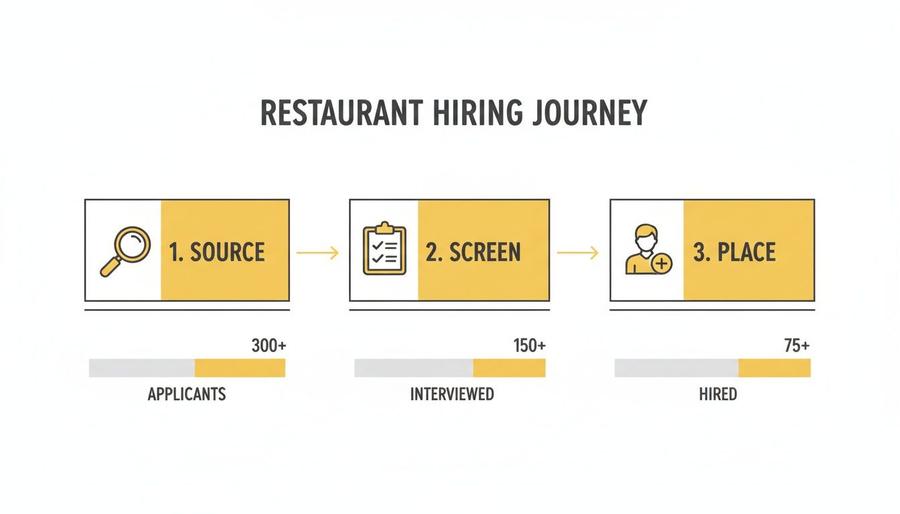
Every step is designed to filter for quality, making sure the final candidates are not just qualified on paper, but are a genuine fit for your culture and operational needs.
Agency Fee Structures at a Glance
To make it even clearer, here is a quick look at how these fee structures typically apply to different types of restaurant roles. This table should give you a solid baseline for what to expect when you start talking numbers with an agency.
These ranges reflect the specialized skills and intense demand for talent in our industry. While the numbers might seem high at first glance, they often pale in comparison to the hidden costs of a bad hire or a prolonged vacancy.
Calculating Your Return on Investment
To really understand an agency's value, you have to do the math on the "soft costs" of DIY hiring. These are the expenses that do not show up on a P&L but drain your resources all the same. Trust me, they add up fast.
Think about all the hours you or your managers sink into tasks like:
- Writing job posts that actually attract the right people.
- Sifting through hundreds of résumés (most of them completely irrelevant).
- Conducting endless phone screens just to find a few decent candidates.
- Scheduling and holding multiple rounds of interviews.
- Chasing down references and running background checks.
Every hour spent on that is an hour not spent running the floor, coaching your team, or talking to guests. Then there is the massive financial hit of a bad hire—wasted training, damage to team morale, and the cost of starting the whole painful process over again. Getting these expenses under control is a critical part of your restaurant’s health. If you want to dig deeper into the numbers, check out our guide on how to calculate labor cost percentage.
The hospitality industry is notorious for talent shortages, and that drives costs up. For example, temporary staffing markups in restaurants can easily hit 35% to 50% over the base wage, which is a good bit higher than in other sectors. That premium reflects just how complex our operations are and how fierce the competition is for skilled BOH and FOH professionals. For a deeper dive, the full U.S. benchmark report on restaurant recruiting fees lays out the data.
When you add up your own time, the risk of a mis-hire, and the going market rates, that agency fee starts to look less like a cost and more like a smart, strategic investment.
The Pros and Cons for Restaurants and Job Seekers
Hiring a restaurant job placement agency is not a magic fix for every staffing headache. It is a strategic decision, and like any good strategy, it comes with a distinct set of trade-offs for both the restaurant trying to hire and the professional looking for their next gig. You have to look at both sides of the coin to figure out if it is the right move for you.
For restaurant owners and managers, the upside can be huge and almost immediate. But those benefits come with real costs and operational shifts that need a hard look.
Advantages for Restaurants
The biggest reason operators turn to agencies is simple: saving time and getting access to better talent, faster. Instead of getting buried in an avalanche of unqualified résumés, you get a short, curated list of professionals who have already been put through the wringer.
This means you get to skip the most draining parts of hiring. Just think of all the hours you will not spend writing job ads, sifting through applications, and doing endless first-round phone screens. An agency does that heavy lifting, freeing you and your leadership team up to actually run the business.
Here is where they really shine:
- Access to a Wider Talent Pool: Agencies have deep networks, and that often includes "passive candidates"—the talented folks who are not desperately scrolling job boards but are open to hearing about a killer opportunity.
- Specialized Expertise: A good hospitality recruiter gets the nuances of our industry. They know the real difference between a line cook and a sous chef and can properly vet the specific skills needed for every role, from the dish pit to the dining room.
- Reduced Time-to-Hire: With a bench of pre-vetted candidates ready to go, you can often fill a critical role in a fraction of the time it would take to start from scratch on your own.
Drawbacks for Restaurants
Of course, this kind of service does not come free. The most obvious downside is the direct cost; that placement fee can be a serious expense, especially for smaller, independent spots trying to make every dollar count.
But it is not just about the money. There is also the risk of a bad culture fit. If a recruiter does not take the time to really understand your restaurant's vibe, your values, and how your team works together, they might send you candidates who look perfect on paper but are toxic for your environment.
A bad cultural hire is expensive and disruptive. It can tank team morale and land you right back where you started: with another empty spot on the line. This is why it is so critical to address the root causes of why people leave in the first place. You can learn more about that in our guide on how to reduce employee turnover.
Advantages for Job Seekers
For hospitality professionals, a great placement agency can feel like having a secret weapon. They act as your personal agent, connecting you with opportunities you would never find on your own because many of them are not even publicly advertised.
This gives you an inside track to exclusive roles at top-tier restaurants. Recruiters also provide priceless coaching, helping you tighten up your resume, nail the interview, and negotiate for a better salary and benefits package. They are in your corner because when you succeed, they succeed.
Drawbacks for Job Seekers
The main catch for candidates is that an agency can only show you what is on its shelf. You will only be considered for jobs with the restaurants they are partnered with, which means you could be missing out on other amazing opportunities elsewhere.
Working with a recruiter means you gain an advocate, but you are also competing against other highly qualified candidates from their network. The process can sometimes feel less direct than applying to a restaurant yourself.
Ultimately, the key for any candidate is to clearly show the value you bring to the table. For anyone trying to build a career in this competitive industry, developing strong interpersonal skills is what will get you hired and help you thrive. Those are the qualities that make you stand out from everyone else in the recruiter's pipeline.
How to Choose the Right Agency for Your Restaurant
Picking a restaurant job placement agency is not like choosing a new linen supplier. This is a major business decision. The right partner becomes a true extension of your team—someone who gets your brand, understands your kitchen culture, and helps you build a crew that actually sticks around.
Get it wrong, though, and you are looking at a costly mistake. You will waste time sifting through candidates who do not fit and burn cash on a partnership that goes nowhere.
Making the right call means being methodical. You have to ask the tough questions, know what to look for, and spot the red flags before you sign anything. This is about more than just filling an empty slot; it is about finding a strategic ally who will help your restaurant grow.
Key Criteria for Your Evaluation
Before you even start dialing numbers, you need a clear framework. Let’s be honest, not all agencies are created equal. A firm that is brilliant at placing tech executives is probably going to fall flat when it comes to finding you a rockstar sous chef. Your first step is to filter out the generalists and zero in on the specialists who live and breathe hospitality.
Look at their area of expertise. Do they focus 100% on restaurants and hotels, or is hospitality just a small slice of their business? A dedicated focus means they have a much deeper network of real talent and a genuine understanding of our industry’s unique grind.
Next, get granular on their process. A solid agency will have a transparent, rigorous system for finding and vetting candidates. You are not just looking for someone to scan resumes. You need a partner who conducts in-depth interviews, knows how to verify culinary skills, and actually picks up the phone to do thorough reference checks.
Essential Questions to Ask Potential Agencies
Once you have a shortlist, it is time to interview them. Treat this process with the same seriousness you would bring to hiring a new GM. The answers they give will tell you everything about their capabilities, their ethics, and whether they are the right fit for your operation.
Here is a checklist to guide those crucial conversations:
- How do you find candidates that are not on the public job boards? The best agencies have a deep, private network of passive candidates—those talented professionals who are not desperately looking but are open to the perfect opportunity.
- What is your process for really understanding our restaurant’s culture and specific needs? The recruiter should want to come to your restaurant, meet your team, and get a feel for the vibe. If they do not ask, they cannot possibly find a true culture fit.
- Can you walk me through your exact screening and vetting process? Push for specifics. What are their interview techniques? How do they assess skills for BOH roles? How deep do their reference checks go?
- What is your fee structure and your guarantee policy? Get this in writing. A reputable agency will offer a guarantee period, usually 90 days, where they will find a replacement at no extra cost if the first hire does not pan out.
- Who will be our day-to-day contact, and what is their background in hospitality? You want to work with a recruiter who has actually worked in a restaurant, not someone who just learned the lingo last week.
A huge part of finding the right fit is making sure the agency knows how to talk about your brand. For a deeper dive, check out our guide on how to write a compelling job description to see what actually gets top talent to pay attention.
Red Flags to Watch For
Knowing what to look for is only half the battle. You also need to know what to avoid. Certain behaviors are dead giveaways that an agency might not have your best interests at heart.
A pushy recruiter who pressures you for a quick decision is a massive red flag. Good recruiters are consultants, not used-car salesmen. Another warning sign is a fee structure that is confusing or murky. If they cannot explain their costs in a simple, transparent way, it is time to walk away.
And be very wary of agencies that flood your inbox with a high volume of resumes without any real curation. That is a classic sign they are just throwing stuff at the wall to see what sticks, instead of doing the hard work of finding a genuine match. Your goal here is a partner who values quality over quantity and is invested in your long-term success.
Exploring Modern Alternatives to Traditional Agencies
The hiring world does not stand still. While a traditional restaurant job placement agency is still a solid resource, it is no longer the only game in town. Smart operators are looking at new ways to build stronger, more resilient teams with tools that give them more control.
Today, two powerful alternatives are shaking things up: building an in-house recruiting function and using advanced hiring platforms. Each path offers a different set of trade-offs in cost, control, and strategy. The right choice really comes down to your restaurant's size, budget, and where you want to be in a few years.

The In-House Recruiting Approach
Taking your hiring in-house is the ultimate play for controlling your brand and culture. Instead of outsourcing, you dedicate an internal team member—or even a small department—to own the entire process. This person lives and breathes your restaurant's mission, making them the perfect ambassador to find people who just get it.
The upside is compelling:
- Total Brand Alignment: Nobody understands your vibe, values, and operational headaches better than someone on the inside.
- Long-Term Cost Savings: Sure, there is an upfront investment in salary and tools. But over time, it can be far more cost-effective than paying agency fees for every single hire.
- Deeper Candidate Relationships: Your team builds direct connections, creating a better experience for applicants and a stronger talent pipeline for future openings.
But this path is not for everyone. The biggest hurdle is the heavy lift in time and resources. You are not just hiring a person; you are building an entire function from the ground up, which needs tools, training, and a serious commitment from leadership. It is a marathon, not a sprint.
The Rise of Modern Hiring Platforms
A new breed of hiring platform is bridging the gap between old-school agencies and a full-blown in-house team. These tech-forward solutions, like MAJC, give you the best of both worlds—powerful tools to manage your own hiring, but with a serious strategic advantage.
Think of it as having an expert recruiter's toolkit right at your fingertips. Platforms like MAJC are built by and for hospitality operators, so they are designed to solve the real-world pain points we all face.
These platforms are not just job boards. They are a full ecosystem of tools, training, and community support designed to tackle the entire employee lifecycle, from the first interview to long-term retention.
Consider this: manager roles make up a massive 43.6% of the global hospitality staffing market, a clear sign that finding and keeping great leaders is top of mind for everyone. This is driven by the industry's notoriously high churn, where front-line staff might only stick around for four to six months. Modern platforms hit this problem head-on with tools like AI-powered interview automation and upskilling academies, directly addressing the 76% five-year jump in hospitality apprenticeships. You can dig into the global hospitality staffing trends to see the full picture.
A New Way to Build Your Team
Platforms like MAJC offer a suite of features that go way beyond what a simple job board can do. Instead of just sending you a pile of resumes, they help you find the right people and give them a reason to stick around.
Here is how they create a more sustainable approach:
- AI-Powered Matchmaking: Smart algorithms connect you with candidates whose skills, experience, and career goals are a genuine fit for your open roles.
- Automated Scheduling: This feature kills the endless email chains for setting up interviews, saving you and your candidates a ton of administrative headaches.
- Peer Support Network: Getting access to a community of fellow operators is invaluable for sharing insights, advice, and resources for your toughest hiring challenges.
Ultimately, these modern tools give you the power to build a stronger, more stable team. They offer a potent mix of technology and human connection, positioning you to not just fill seats, but to find and grow the next generation of leaders for your restaurant.
To help you weigh your options, we put together a simple breakdown comparing the three main paths.
Comparing Your Hiring Options
Each approach has its place. The key is to find the one that aligns with your budget, your timeline, and your vision for building a team that lasts.
What’s Happening in Hospitality Staffing Right Now?
To really get why a good restaurant job placement agency is worth its weight in gold, you have to look at the big picture. The entire hospitality world is going through a massive shift, fueled by a booming market on one side and a relentless staffing crunch on the other. These are not just abstract trends; they are the forces shaping your day-to-day reality, making smart hiring more critical than ever.
That feeling of constantly needing skilled people? It is not just you. It is a real, measurable economic tidal wave, and it puts constant pressure on operators to keep their teams solid and performing at a high level. In this climate, finding the right people is not just about growth—it is about survival.
A Market That’s Exploding
The staffing market itself tells the story. Right now, the U.S. hospitality staffing market is a USD 166.49 billion industry. By 2032, it is expected to hit USD 258.72 billion. That is a steady climb of 6.5% every year, driven by the endless demand from restaurants and hotels fighting to get ahead of high turnover. You can dig into more of the numbers on this expanding hospitality market report from Coherent Market Insights.
And this is not just about finding more line cooks. The real action is in leadership and specialized roles—the positions that are toughest to fill and make the biggest difference to your bottom line.
Here is where the demand is most intense:
- Management Roles: This is the biggest piece of the pie, making up 41.2% of the market. It screams one thing loud and clear: operators are desperate for qualified managers who can actually lead, control costs, and keep guests happy.
- Food and Beverages: This segment accounts for 46.7% of the market. It is powered by restaurants, of course, but also by a growing events and catering scene that needs skilled, flexible teams ready to go at a moment's notice.
When you see this kind of intense demand, especially for leaders, the role of a specialized agency clicks into place. They exist to solve this exact problem, connecting you with vetted, high-impact people who can help you thrive.
How These Trends Affect Your Hiring Game
These are not just numbers on a spreadsheet; they are the challenges you deal with every single day. The constant churn of turnover, the endless search for a reliable GM, and the pressure of rising guest expectations all add up to a whole lot of operational strain. A restaurant job placement agency is basically a pressure-release valve.
When you partner with experts who live and breathe these market trends, you are not just filling an empty spot on the line. You are shifting to a proactive strategy to build a stronger, more stable team for the long haul. It lets you get back to running your business, knowing the hiring is in the hands of people who are navigating the same choppy waters you are.
Questions We Hear All the Time
Navigating the world of recruitment agencies can feel like a maze. Let's clear up a few of the most common questions restaurant operators ask.
How Long Does It Really Take to Fill a Position?
Honestly, it depends. An agency might find you a solid line cook in just a few days if the market is right. But sourcing, vetting, and landing a top-tier executive chef? That could easily take several weeks, especially if your requirements are very specific.
The good news is that modern platforms using smart matchmaking technology are definitely speeding things up. By filtering for skills, experience, and even culture fit automatically, they can cut down the time-to-hire pretty significantly without you having to sacrifice on quality.
Are Agency Fees Set in Stone?
Not always. While most firms have their standard rates, there is often room to negotiate. You will find they are more flexible if you are looking to fill multiple roles or if you are willing to sign an exclusive partnership agreement.
But remember, the goal is not just to get the lowest price—it is to get the best value. A great hire who stays and grows with your business is a far better investment than a cheap hire who walks out in three months.
What Happens If the New Hire Is a Bust?
This is a critical question and one of the biggest reasons to work with a professional service in the first place. Any reputable agency will offer a guarantee period on their placements, which is usually around 90 days.
If the candidate quits or you have to let them go for performance reasons within that window, the agency should find you a replacement at no extra charge. Think of it as an insurance policy. It is a crucial safety net that protects your investment and makes sure you end up with the right person on your team.
Ready to build a stronger, more stable team with less stress? MAJC gives you the tools, training, and community support to hire smarter and retain longer. Explore how our platform can transform your restaurant's future.