

On this page 25 sections
- What Are Restaurant Recruitment Agencies?
- Why They Matter More Than Ever
- A Strategic Partner for Growth
- Understanding Agency Services and Fee Structures
- What Services Do They Actually Offer?
- Demystifying the Fee Structures
- Comparing Recruitment Agency Fee Structures
- Weighing the Pros and Cons of a Hiring Partner
- The Clear Advantages of Using an Agency
- Potential Drawbacks to Consider
- How to Choose the Right Recruitment Agency
- Evaluating an Agency’s Niche and Expertise
- A Practical Checklist for Vetting Agencies
- Powerful Questions to Ask Potential Partners
- Red Flags to Watch Out For
- Maximizing the Return on Your Recruitment Investment
- Calculating the True Value of a Strategic Hire
- Building a Partnership That Pays Dividends
- Building a Sustainable In-House Talent Pipeline
- Cultivating an Irresistible Employer Brand
- From External Support to Internal Strength
- Answers to Your Toughest Recruiting Questions
- How Long Does This Actually Take?
- What Happens If the New Hire Quits or Gets Fired?
- Can I Use an Agency for Seasonal or Temp Staff?
It’s Friday night, mid-service, and your star line cook is a no-show. That sinking feeling is an all-too-common reality in this industry, and it highlights the exact problem restaurant recruitment agencies were built to solve.
Don't mistake these agencies for a simple job board. Think of them as strategic hiring partners who handle the entire grind for you, from finding and vetting talent to interviewing and onboarding.
What Are Restaurant Recruitment Agencies?
Imagine having a specialized sous chef, but for your HR needs. They know exactly where to find the best ingredients (candidates) and how to prep them for your kitchen or dining room. In today's tough labor market, their role isn't just a luxury; it's becoming essential for building a team that can actually handle the heat of service.
This guide will walk you through how they work, why they're so valuable, and when it makes sense to bring one on board. We’ll get into the specific services they offer and how they help you break the costly cycle of bad hires. Because let’s be honest, our industry has unique staffing challenges, and these agencies offer a focused solution.
Why They Matter More Than Ever
The hospitality industry is famous for its revolving door. The employee turnover rate often spikes to around 75% annually for frontline staff, a number that puts incredible pressure on operators. This constant churn isn't just disruptive; it's incredibly expensive.
A good recruitment agency helps you sidestep those costs by connecting you with professionals who are a better fit from day one. You can learn more about tackling this head-on in our guide on how to reduce employee turnover.
A sharp agency knows the subtle differences that matter:
- Back-of-House: They can spot the difference between a line cook who’s great at high-volume service and a sous chef with the creative chops for menu development.
- Front-of-House: They know how to find a GM who’s a wizard with inventory and P&Ls versus one whose real talent is building a magnetic team and creating an unforgettable guest experience.
A Strategic Partner for Growth
At the end of the day, these agencies do more than just fill a spot on the schedule. They act as partners who are genuinely invested in your restaurant's long-term health.
They save you countless hours you’d otherwise spend sifting through résumés, conducting dead-end interviews, and chasing down references. This frees you up to focus on what you do best: running your business and taking care of your guests. Their goal is to find people who won't just do the job well, but who will add to your culture and stick around for the long haul.
Understanding Agency Services and Fee Structures
When you bring in a restaurant recruitment agency, you're not just buying a list of names. You're investing in a specialist service built to save you the one thing you never have enough of: time. These firms don't just post a job ad and hope for the best. They actively hunt for, screen, and present professionals who actually fit what you need, whether it's for the front of house or the back.
This is a big reason the global hospitality staffing market has grown significantly. A recent report from Grand View Research noted that restaurants accounted for over 40% of revenue share in the U.S. hospitality staffing market. It's proof that operators are leaning hard on these focused hiring partners to find the right people.
The infographic below breaks down the typical journey an agency takes, from finding candidates all the way through to getting them onboarded.
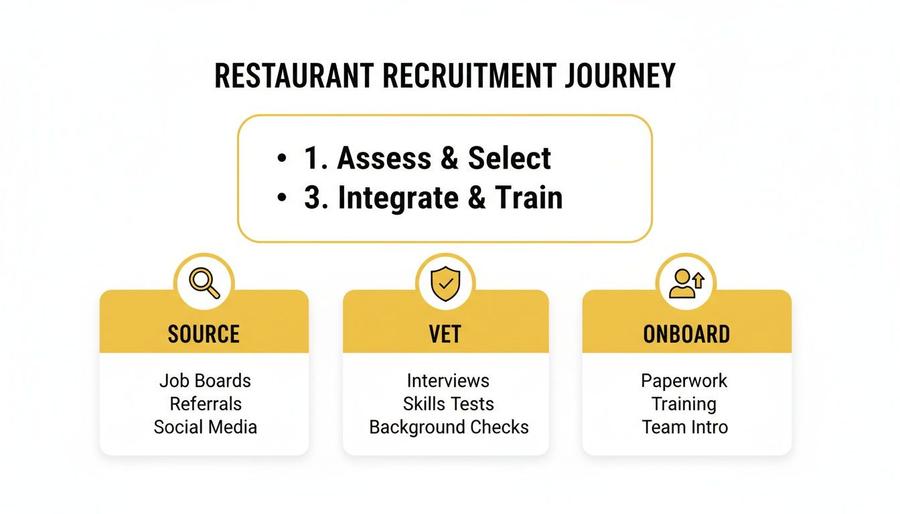
Think of a good agency as an extension of your own team. The team handles the heavy lifting of sourcing, vetting, and prepping candidates so you can focus on running your restaurant.
What Services Do They Actually Offer?
Not every open role requires the same approach. Agencies get this, so they offer different models to fit your specific situation. Knowing the lingo helps you pick the right tool for the job, whether you're hiring a prep cook or a new General Manager.
- Contingency Search: This is the most common setup. You only pay the agency's fee if you actually hire a candidate they bring you. It’s a low-risk way to go, perfect for filling mid-level roles like line cooks or assistant managers where you might be looking for people on your own, too.
- Retained Search: Got a critical leadership role to fill, like an Executive Chef or Director of Operations? This is where a retained search comes in. You pay a portion of the fee upfront to lock in the agency's dedicated time and resources. It’s an exclusive partnership that ensures a deeper, more confidential hunt for top-tier talent.
- Temp-to-Perm Contracts: This is your "try before you buy" option. If you need to fill a spot fast or want to see how someone fits with the team before making a full commitment, this model is a lifesaver. An agency places a temporary employee with you, and you get the option to hire them permanently after a set period. It's great for handling seasonal rushes or covering for an employee on leave.
Demystifying the Fee Structures
Let's be honest, the price tag for a recruiter can feel steep at first. But you have to understand what you're paying for. A great hire adds incredible value, while a bad one can cost you thousands in lost productivity, wasted training, and team morale.
The most common fee is a percentage of the candidate's first-year annual salary, usually somewhere between 15% to 25%. So, for a General Manager you hire at an $80,000 salary, a 20% fee would run you $16,000.
To help you compare your options, here’s a quick breakdown of the common fee models you’ll encounter.
Comparing Recruitment Agency Fee Structures
Some agencies might also offer a flat-fee arrangement, where you agree on one fixed price for the placement, no matter the final salary. This is really helpful for budgeting, especially if you're hiring for several similar roles at once.
No matter the model, always make sure your agreement clearly spells out the fee structure and any guarantee period. That’s your safety net if the new hire doesn't work out in the first few months. The clearer you are from the start, the better the result. And that clarity begins with a rock-solid job description. For more on that, check out our guide on how to write a job description that gets the right people to apply.
Weighing the Pros and Cons of a Hiring Partner
Bringing on a restaurant recruitment agency is a big move. It’s more than just a budget line item; it’s a strategic choice that impacts your team, your brand, and most importantly, your time. Like any business partnership, there are some serious upsides and a few potential pitfalls worth thinking through.
For some operators, an agency is a lifeline in a brutal hiring market. For others, the cost or the risk just doesn't pencil out. Understanding both sides of the coin is the only way to make a call that fits your restaurant’s reality.
Let’s break it down.
The Clear Advantages of Using an Agency
The most immediate win? You get your time back. Plain and simple. Instead of drowning in a sea of résumés and sitting through endless first-round interviews, you can get back to running your restaurant. A good agency does the heavy lifting, bringing you a handful of qualified, pre-vetted candidates who are actually worth talking to.
This focused approach comes with a few other major pros:
- Access to the Hidden Talent Pool: The best people are often already working and aren't scrolling through job boards. Recruiters have deep networks and can tap into this passive talent pool, connecting you with candidates you’d otherwise never find.
- Real Industry Know-How: A specialized agency gets the restaurant world. They know the difference between a high-volume line cook and a fine-dining sous chef, ensuring the people they send have the right chops for your specific kitchen.
- Confidential Searches: Need to replace a GM or an Executive Chef without tipping off your team or the public? An agency can run a quiet, confidential search, protecting you from internal drama and external speculation.
Think about a multi-unit operator I know who was expanding into a new city. Instead of trying to build an entire team from scratch in a market she didn't know, she hired a local agency. They delivered a top-tier GM and Executive Chef who knew the scene inside and out. The new spot opened on time and killed it from day one. That’s the power of a good partner.
Potential Drawbacks to Consider
Of course, it’s not all smooth sailing. The biggest hurdle for most is the cost. Placement fees typically run from 15% to 25% of a candidate's first-year salary. For an independent restaurant watching every dollar, that’s a significant investment.
With frontline turnover stuck around 75%, many operators see agency fees as a necessary evil to keep their doors open. The U.S. hospitality staffing market is projected to grow substantially for this very reason. You can dig into the full hospitality staffing market analysis to see just how big this challenge is.
But it’s not just about the money. Other potential cons include:
- The Risk of a Culture Mismatch: If a recruiter doesn’t truly get your brand’s vibe and what makes your team tick, they might send you candidates who look perfect on paper but are a terrible fit. This leads to a quick exit, and you're right back where you started.
- Giving Up Direct Control: When you hand over the initial screening, you’re trusting someone else’s judgment. That requires a massive amount of faith that the agency understands exactly what you’re looking for.
- Becoming Too Dependent: Relying on an agency for every hire can keep you from building your own internal recruiting muscle and a direct pipeline of talent for the future.
A restaurant recruitment agency can be a game-changer, especially for critical leadership roles or during a big growth push. But its success hinges on finding a partner who genuinely understands your vision and proving the cost is worth the value of a quality, long-term hire.
How to Choose the Right Recruitment Agency
Picking the right restaurant recruitment agency is one of the most important calls you’ll make. This isn’t just about filling a role; it’s about finding a partner who gets your brand, your culture, and the unique pressures of your operation. The wrong choice leads to expensive mismatches, while the right one can become a long-term ace up your sleeve.
Making a smart decision starts with a clear-headed evaluation. You have to look past the sales pitch and dig into an agency’s actual track record, its niche, and how it finds great people. A little diligence upfront will save you a world of headaches and cash down the road.
Evaluating an Agency’s Niche and Expertise
Not all agencies are created equal. A recruiter who specializes in placing fine-dining executive chefs probably isn’t the best fit to staff your new fast-casual spot. Your first job is to make sure their expertise lines up with what you actually need.
An agency’s real value comes from a deep, almost obsessive, understanding of a particular segment. They should know the difference between the skills needed for a front-of-house manager in a high-volume chain versus a boutique, chef-driven restaurant. Their network and screening process should reflect that specialized knowledge.
A great way to test this is to ask about recent placements similar to your open role. If they can’t point to relevant examples, they might not have the focused experience you’re paying for.
A specialized recruiter understands the unique operational demands of your restaurant segment. Their ability to assess for both technical skills and cultural fit is what separates a good agency from a great one.
A Practical Checklist for Vetting Agencies
Once you have a shortlist, it’s time to get serious. Use this checklist to systematically vet each potential partner and make sure they meet your standards before you sign anything.
- Review Their Track Record: Ask for hard numbers on their placement success rates and, more importantly, the average tenure of the candidates they’ve placed. An agency that brags about quick hires but can’t back it up with retention data is likely focused on volume, not quality.
- Check Client Testimonials and References: Go beyond the curated quotes on their website. Ask for contact information for two or three recent clients in your segment and have a real conversation about their experience.
- Analyze Their Screening Process: How do they actually vet candidates? Do they conduct in-depth behavioral interviews, skill assessments, and thorough reference checks? A rigorous process is a huge indicator of a quality-focused agency.
- Confirm Industry Connections: Do they have a strong network in the local or national restaurant community? Their connections to culinary schools, industry associations, and top talent are a huge part of what you’re paying for.
Powerful Questions to Ask Potential Partners
The interview process goes both ways. Asking sharp, specific questions will reveal how an agency really operates and whether it’s truly equipped to find the right person for your team.
- How do you assess a candidate for cultural fit with our specific brand?
- Walk me through a difficult placement you handled and what you learned from it.
- What is your process for sourcing candidates who aren’t actively looking for a job?
- Can you describe how you would present our restaurant's opportunity to a top candidate?
- What is your guarantee period, and what exactly does it cover if a new hire doesn’t work out?
These questions push past the canned answers and force a recruiter to show their real-world expertise. For more ideas, check out our guide on essential restaurant manager interview questions, which you can adapt when vetting an agency.
Red Flags to Watch Out For
Just as important as knowing what to look for is knowing what to avoid. Be wary of any agency that shows these warning signs, as they often lead to disappointing results.
- High-Pressure Sales Tactics: A good partner acts as a consultant, not a salesperson. If you feel rushed or pressured into signing a contract, it’s a major red flag.
- Lack of Transparency: Fees, processes, and guarantees should be crystal clear. Any hesitation to put details in writing is a sign of trouble ahead.
- Overpromising Results: Be cautious of recruiters who guarantee a perfect candidate in an unrealistic timeframe. The hiring process takes time, and honest partners are upfront about that.
- Poor Communication: If they’re slow to respond or unclear in their communication during the sales process, imagine what it will be like once you’re paying them.
Choosing the right agency is a critical business decision. By taking a structured approach, you can confidently select a partner that will help you build a stronger, more resilient team.
Maximizing the Return on Your Recruitment Investment
Let’s be honest: hiring a restaurant recruitment agency is a serious line item on your budget. To make it pay off, you have to look past the placement fee and calculate the real return on that investment (ROI). The true cost of an empty seat, especially a leadership one, isn’t just the salary you’re not paying. It’s a ripple effect of lost sales, team burnout, and service that’s just a little bit off, all of which can slowly chip away at your brand.
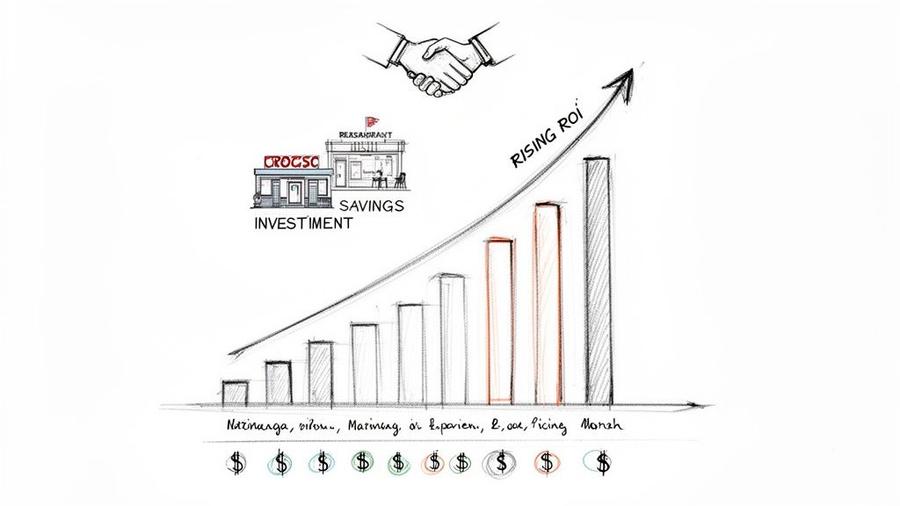
When you start looking at this partnership through an ROI lens, your mindset shifts. You’re not just plugging a hole in the schedule; you’re making a strategic investment in your business’s future. The right hire, brought to you by a skilled agency, can generate value that makes that initial fee look like a bargain.
Calculating the True Value of a Strategic Hire
Let's ground this in a real-world scenario. A busy downtown restaurant paid $10,000 to hire a new General Manager through a specialized agency. That number might make you wince. But the hidden costs of leaving that position open were piling up fast. The previous GM’s abrupt departure left a leadership vacuum, leading to disorganized shifts and a noticeable drop in service standards that regulars were starting to comment on.
The new GM, who was carefully vetted by the agency for both skills and culture fit, turned things around in just three months. They tightened up schedules, cut down on waste, and got team morale back on track. The result? A 15% increase in nightly revenue and a huge drop in employee turnover. In just six months, those operational fixes generated over $30,000 in new revenue and savings, delivering a three times return on the recruitment fee.
A great hire doesn't cost you money; they make you money. The agency’s fee is simply the investment that unlocks that potential.
Building a Partnership That Pays Dividends
The global staffing and recruitment market ballooned to USD 757.56 billion in 2023. That explosive growth isn't just hot air, it's driven by real efficiency. The right agencies can slash hiring times by up to 40%.
To get the most out of this relationship, you have to treat your recruiter like an extension of your own team. This isn’t just a transaction; it's a collaboration.
Here are a few ways to make that happen:
- Give Clear, Honest Feedback: Don’t just say "no thanks." Explain why a candidate wasn't the right fit. Was it their experience, their energy, or something else? That specific feedback helps the recruiter dial in their search and get closer to your perfect match, faster.
- Be Responsive and Available: The best candidates are never on the market for long; they’re usually juggling multiple offers. If you want to land top talent, you have to move quickly. Make time for interviews and give feedback right away, or you’ll lose them to someone else.
- Share the Big Picture: Don't just email over a job description. Get on the phone and talk to your recruiter about your restaurant's mission, your five-year plan, and the kind of culture you're trying to build. That context is gold. It helps them find someone who doesn’t just fit the role, but fits your vision.
As you work to get the most out of your recruitment investment, it's also smart to explore different tools that can give you a competitive edge. Looking into the top pre-employment assessment tools can help you refine your process even further. At the end of the day, a strong partnership ensures your recruitment dollars deliver value that lasts.
Building a Sustainable In-House Talent Pipeline
Recruitment agencies are a fantastic tool for filling a tough role or staffing up fast, but the real endgame is building a hiring process so strong you barely need them. The best operators I know use agencies as strategic partners for specific, high-stakes hires, not as a permanent crutch.
The long-term win is creating a workplace so compelling that the best people in your city are knocking on your door.
This means shifting your focus from just filling empty slots to building a sustainable talent pipeline. It’s an investment, for sure, but one that pays off for years by giving you a stable, motivated team that wants to grow with you. And the foundation of that pipeline isn't some complicated software; it’s just being a great place to work.
Cultivating an Irresistible Employer Brand
Your employer brand is what your team says about working for you when you're not in the room. It’s the sum of your culture, your leadership, and their daily experience. A strong brand turns every employee into a recruiter, attracting other great people who want in on what you're building.
You can start by focusing on three core areas:
- Foster a Positive Work Culture: This is more than just staff meals or a holiday party. It means building an environment of respect, open communication, and real support where people feel valued and safe.
- Create Clear Career Paths: People stick around when they can see a future. Show them the path from dishwasher to line cook, from server to manager, and from manager to a multi-unit leader. Make it real.
- Leverage Your Team for Referrals: Your best people know other great people. A simple, well-structured employee referral program is one of the most powerful and cost-effective ways to find high-quality candidates who already fit your culture.
Building this kind of environment is the most effective long-term recruiting strategy, period. It cuts your reliance on outside help and creates a virtuous cycle where great people attract more great people.
From External Support to Internal Strength
Moving toward a stronger in-house process doesn’t mean you have to fire your recruiter. It just means you start using them more strategically. Think of them as specialists you call for the toughest searches, like finding an executive chef with a niche skillset or staffing a new location in a market you don't know.
As you build out your own systems for hiring and retention, understanding the distinction between policy and procedure becomes critical. Having clear, documented ways of doing things makes your hiring more consistent and effective, taking the guesswork out of it.
This is a gradual shift. You might start by handling all front-of-house hiring internally while still leaning on an agency for specialized back-of-house roles. Over time, as your reputation grows and your referral network kicks in, you’ll find you can handle more and more of it yourself. Our guide on how to build high-performing teams offers a practical roadmap for making this happen.
The goal isn't to eliminate recruiters from your toolkit. It's to make them a choice, not a necessity. By focusing on building a restaurant where the best people want to work and stay, you create the most durable competitive advantage there is: a strong, stable, and deeply committed team.
Answers to Your Toughest Recruiting Questions
Let's be honest, bringing on a recruitment agency can feel like a big step, and you probably have a lot of practical questions. We hear them all the time from operators. Here are some straight answers to help you decide if it's the right move for your restaurant.
How Long Does This Actually Take?
It’s the million-dollar question, and the real answer is: it depends. For front-of-house roles or line cooks, a sharp agency can often get you qualified candidates to look at within one or two weeks. You could be making an offer not long after that.
But if you're hunting for a new General Manager or an Executive Chef with a very specific skill set, you need to be more patient. That kind of search is deeper and more involved. Expect it to take anywhere from four to eight weeks to find the right leader who truly fits your culture.
A few things can speed up or slow down the clock:
- The Role Itself: A niche position is just going to take longer. No way around it.
- The Market: If everyone is hiring, it’s a dogfight out there for talent.
- Your Speed: The faster you can give feedback and clear your calendar for interviews, the more momentum you build.
What Happens If the New Hire Quits or Gets Fired?
This is a huge concern, and any agency worth its salt has a safety net for you. Most reputable restaurant recruitment agencies offer a guarantee period, which usually runs for 30 to 90 days.
If your new hire leaves or you have to let them go during that window (for performance reasons, not layoffs), the agency will jump back in and find a replacement candidate, at no extra charge.
Always, always read the guarantee clause in your contract before you sign. Understand the time frame, the terms, and what's expected of you. This is your insurance policy on a major investment.
Can I Use an Agency for Seasonal or Temp Staff?
Absolutely. In fact, this is one of their most valuable services, especially for restaurants in tourist towns or anyone needing an extra set of hands for the holidays. It lets you staff up for the rush without taking on the long-term payroll commitment.
It’s also a great way to "try before you buy." Many agencies offer temp-to-perm contracts. You get to see how a cook works the line or how a server handles a busy Saturday night before you decide to make a permanent offer. That kind of flexibility can be a game-changer.
Ready to build a stronger team without the hiring headaches? MAJC provides the tools, training, and community support to help you attract and retain top talent. Explore our platform to see how you can run a smarter, more profitable restaurant.