

On this page 25 sections
- Why Cost Per Hire Is a Critical Restaurant Metric
- The Foundational CPH Formula
- The Core Cost Per Hire Formula at a Glance
- More Than Just a Number
- Identifying Every Expense in Your Hiring Process
- Internal Recruiting Costs
- External Recruiting Costs
- The Hidden Costs You Can't Ignore
- Putting the CPH Formula to Work in Your Restaurant
- Scenario One: Hiring a Line Cook
- Scenario Two: Hiring a Server
- Scenario Three: Hiring a Restaurant Manager
- So, Is Your Cost Per Hire Good or Bad?
- What's a Typical CPH in Hospitality?
- The Big Variables That Drive Your CPH Up or Down
- Proven Strategies to Lower Your Restaurant's CPH
- Build an Employee Referral Program That Actually Works
- Strengthen Your Employer Brand
- Streamline Your Interview and Screening Process
- Focus on Retention to Stop the Cycle
- Common Questions About Cost Per Hire
- How Often Should I Calculate My Cost Per Hire?
- Does a Low CPH Automatically Mean My Hiring Is Efficient?
- What’s the Biggest Mistake Restaurants Make When Calculating CPH?
- Should I Exclude Bad Hires from My CPH Calculation?
To figure out your cost per hire, the formula is straightforward: add up your total internal and external recruiting costs for a set period, then divide that number by the total number of people you hired in that same timeframe. This simple math gives you a powerful snapshot of what you're spending to bring on new talent.
Why Cost Per Hire Is a Critical Restaurant Metric
In the hospitality world, hiring can feel like a revolving door. What if you could turn that constant expense into a strategic advantage? That's where understanding your Cost Per Hire (CPH) comes in. It’s more than just a number for your HR files; it’s a vital sign for the financial health and operational efficiency of your restaurant.
By consistently tracking your CPH, you get the clarity you need to budget smarter, plan for growth, and build a team that wants to stick around. A high CPH isn't just a number. It's often a symptom of deeper problems, from ineffective job ads to a dragged-out interview process that drains your managers' time and energy.
The Foundational CPH Formula
At its core, the standard CPH formula is simple and universally recognized. Let's break it down.
The Core Cost Per Hire Formula at a Glance
This table gives you a quick summary of the main components that make up the cost per hire calculation.
Cost Category What It Includes Total Recruiting Costs The sum of all expenses related to finding and hiring new employees, both internal and external. Total Number of Hires The final count of all new employees brought on board during a specific period.
The formula itself is: Cost Per Hire = (Total Internal Recruiting Costs + Total External Recruiting Costs) ÷ Total Number of Hires.
While the formula is simple, the results can look wildly different depending on the industry.
For example, the Society for Human Resource Management (SHRM) reports the average cost per hire across all industries is around $4,700. But for restaurant operators dealing with constant turnover, that number can feel like a lowball estimate. This metric is crucial for controlling one of your biggest variable expenses.
More Than Just a Number
Looking at CPH in a vacuum misses the whole point. It’s a key performance indicator that ties directly to your restaurant's profitability and stability. When you know exactly what it costs to fill every open position, you can make much smarter decisions across the board.
- Smarter Budgeting: You can accurately forecast your hiring expenses for the next quarter or year, preventing nasty financial surprises.
- Improved Efficiency: It helps you see which recruiting channels, like job boards or employee referral programs, are giving you the best return on investment.
- Enhanced Retention: A high CPH often points to a broken hiring or onboarding process, which is a direct cause of employee turnover. Fixing the root problem saves you money on both ends.
A well-managed Cost Per Hire isn't about spending less on people. It’s about investing wisely to build a stronger, more stable team that drives your restaurant forward.
This metric is one of several critical numbers you should be watching. Tracking CPH alongside other key restaurant KPIs gives you a clearer picture of your operational health. As we go through this guide, we'll break down every part of this calculation, helping you uncover the true cost of hiring and giving you real strategies to get your spending in check without sacrificing quality.
Identifying Every Expense in Your Hiring Process
To get a real handle on your cost per hire, you need to track every dollar that goes into bringing a new person on board. This means going beyond the obvious things, like the bill from Indeed. It’s about doing a full audit of your entire hiring process to uncover all the direct, indirect, and sometimes hidden expenses that add up.
Think of it like costing out a new menu item. You wouldn't just add up the price of the steak and potatoes; you’d factor in the butter, spices, cooking oil, and even the labor it takes to prep it. That same level of detail is needed to nail down your true cost of hiring.
Internal Recruiting Costs
Internal costs are sneaky because they rarely show up as a line item on an invoice. These are the resources you’re already paying for inside your restaurant that get pulled into the hiring vortex.
The biggest one, almost without fail, is your team's time. A manager’s salary isn’t just for running the floor; a slice of that pie is spent on hiring activities.
Here’s a quick list of what to look for:
- Hiring Manager's Time: This is the hourly wage (or prorated salary) of any manager, chef, or team lead involved in the process. Think writing job descriptions, sifting through résumés, doing phone screens, and sitting in on interviews. If your chef spends two hours on a trial shift with a line cook, that's a direct hiring cost.
- Administrative Time: Don't forget the time your AGM or administrative staff spends coordinating the chaos—scheduling interviews, sending emails, preparing offer letters, and wrangling new hire paperwork.
- Employee Referral Bonuses: This one's easy. If you pay your staff a cash bonus for referring a successful hire, that payment goes right into the internal cost bucket.
- Internal Training and Onboarding: This covers the time your best server or lead cook spends training the new person during their first few weeks. It also includes the cost of training materials, uniforms, or any initial supplies you provide.
Time is money. For salaried employees, calculate their hourly rate (annual salary ÷ 2,080 work hours) and multiply it by the hours they sink into hiring. This is often the single largest hidden expense in the whole process.
External Recruiting Costs
External costs are usually more straightforward because they come with an invoice. These are the expenses you'll find on credit card statements and vendor bills when you pay someone outside your company for a service.
These costs can swing wildly depending on the role. The search for a new general manager is going to look a lot different than hiring a part-time dishwasher.
Here are the most common external costs in our industry:
- Job Board Fees: The classic expense. This is what you pay to post on general sites like Indeed or industry-specific boards like Culinary Agents.
- Recruitment Agency Fees: If you bring in a third-party recruiter or an agency to find a key player like a chef or GM, their commission is a major external cost.
- Background Checks and Screenings: The price of running criminal background checks, drug tests, or verifying certifications falls squarely in this category.
- Advertising and Marketing: Did you boost a job post on social media or run a local ad campaign to get the word out? That spending counts.
- Required Certifications: Don't overlook industry-specific needs. You might cover costs for food safety credentials, a critical expense detailed in this guide to decoding the cost of food handler certificates.
- Applicant Tracking Systems (ATS): The subscription fee for any software you use to manage applications is another clear external cost. Many of the top restaurant apps now have features to help manage this.
The Hidden Costs You Can't Ignore
Beyond the tangible invoices and timesheets, there are opportunity costs that hammer your bottom line. They’re harder to stick a number on, but ignoring them means you’re not seeing the full financial impact of having an open position.
First, there’s the hit to productivity and revenue. An empty server position means a section isn't turning tables, which translates directly to fewer covers and lower sales. An understaffed kitchen line means longer ticket times, which frays the guest experience and can damage your reputation.
Next is the impact on team morale and burnout. When a spot is open, your existing team has to pick up the slack. They’re working longer hours, handling extra duties, and feeling the pressure. This leads to stress, burnout, and a much higher risk of your current top performers walking out the door—which just starts the painful cycle over again.
By building a comprehensive list of every possible expense, you lay the groundwork for a truly accurate cost per hire calculation. This isn't just an accounting exercise; it's a strategic tool that reveals what it costs to build and maintain a winning team.
Putting the CPH Formula to Work in Your Restaurant
Knowing the different costs that go into your cost per hire is a great start, but the real power comes from seeing it all add up. This isn't just theory; it's a practical tool for making smarter financial decisions for your kitchen and your floor.
Let's walk through three common hires to show you how to calculate cost per hire in real-world scenarios. Each example breaks down the hypothetical costs, showing how dramatically the final number can change from one role to the next. You’ll see exactly how the numbers tell a story about where your money and time are truly going.
The following infographic gives a great visual of the typical split between internal and external hiring expenses.
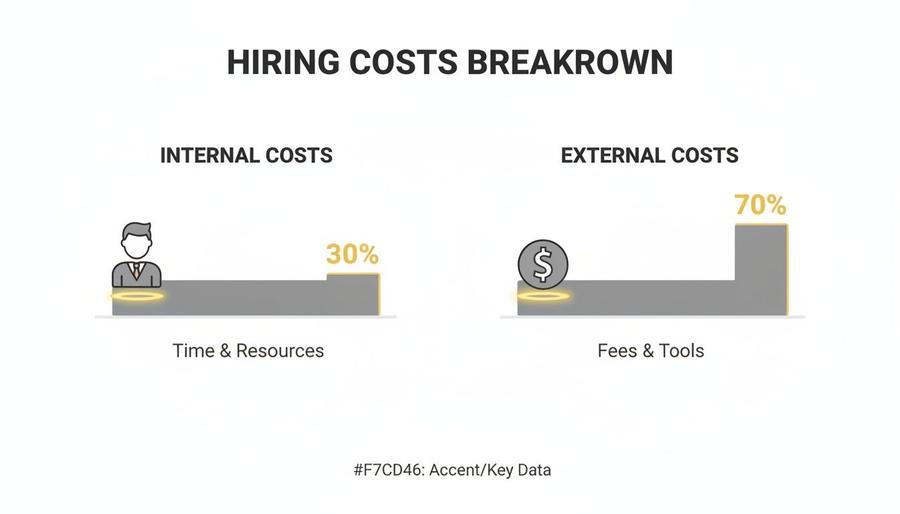
As you can see, a huge chunk of hiring expenses often comes from external sources like job ads and agency fees.
Scenario One: Hiring a Line Cook
Let's start in the back of house. You need a reliable line cook—a role that’s always in high demand. Your executive chef and sous chef are both involved in the process.
Here’s what those costs might look like:
- Job Board Posting: You spend $300 on industry-specific job boards to find experienced candidates.
- Executive Chef's Time: The chef spends six hours total on reviewing applications, phone screens, and in-person interviews. At a $75,000 salary (about $36/hour), this time costs $216.
- Sous Chef's Time: Your sous chef oversees a three-hour paid trial shift. At a $55,000 salary (about $26/hour), that’s $78 of their time.
- Paid Trial Shift: You pay the candidate $20/hour for their three-hour trial, costing $60.
- Onboarding & Training: The new cook needs uniforms ($100) and spends their first 20 hours training with an experienced cook, which is another $400 in labor.
Total Cost: $1,154
CPH for One Line Cook: $1,154
Scenario Two: Hiring a Server
Now, let's move to the front of house. You need a new server to cover a busy section, and your general manager and a lead server will handle the hiring.
This calculation looks a little different:
- Social Media Ad Boost: You spend $100 boosting a hiring post on Instagram and Facebook.
- General Manager's Time: The GM spends four hours on screening and interviews. At an $80,000 salary (around $38/hour), this costs $152.
- Referral Bonus: An existing server referred the candidate, earning them a $250 bonus.
- Onboarding & Uniforms: The new hire gets two company shirts ($50) and spends 15 hours shadowing a lead server, costing $300 in training labor.
- Administrative Time: Your AGM spends one hour processing paperwork, adding another $25.
Total Cost: $877
CPH for One Server: $877
The costs are lower, but they still add up fast. This is also a perfect example of how hiring time is a direct labor expense. For a deeper dive, check out our complete guide on how to calculate labor cost percentage to see how these metrics influence each other.
Scenario Three: Hiring a Restaurant Manager
Finally, the big one: a new Assistant General Manager. This is a critical role, and the investment reflects that. The process is much more involved and pulls time from senior leadership.
Let's itemize the expenses:
- Recruiting Agency Fee: You bring in a specialized hospitality recruiter. Their fee is 15% of the new manager's $85,000 salary, which comes out to $12,750.
- Owner's Time: The restaurant owner is in the final two interviews, spending four hours. Valuing their time at $75/hour, this is a $300 cost.
- GM's Time: The GM spends 12 hours on initial interviews and vetting. At $38/hour, that costs $456.
- Background Check: A comprehensive background check for a management role costs $150.
- Onboarding & Systems Training: The new manager needs specialized training on your POS and scheduling software, plus dedicated onboarding with the owner and GM, easily totaling $1,000 in time and resources.
Total Cost: $14,656
CPH for One Manager: $14,656
These examples clearly show that your CPH is not a single number but a spectrum. A manager hire can cost more than 10 times what it costs to hire a cook, reinforcing the need to calculate CPH for different roles or departments.
By applying this formula to your own hiring, you move from guessing to knowing. This data empowers you to justify budgets, spot inefficiencies, and make strategic decisions that strengthen your team and your bottom line.
So, Is Your Cost Per Hire Good or Bad?
Once you’ve done the math and landed on your cost per hire, the real question pops up: Is that number any good? Just having a number is one thing, but you need context to understand what it's telling you about your restaurant. The hospitality world plays by a completely different set of rules than a tech company or a factory, and our hiring benchmarks show it.
Trying to compare your restaurant's CPH to some national, all-industry average is a waste of time. It's like comparing apples to oranges. Our industry is shaped by high turnover, specific skill sets, and fierce local competition, all of which create a unique financial picture when it comes to hiring. What's considered a "good" CPH for a high-end downtown spot will look different from an efficient QSR on the edge of town.
What's a Typical CPH in Hospitality?
The cost-per-hire profile for hospitality is unique, so it’s critical for operators to know where they stand. Generally speaking, hospitality roles average between $1,000 to $2,500 per hire, according to industry data. But that's just a starting point. Location changes everything. High-demand cities or areas with talent shortages can easily push those costs to $6,000–$10,000, while you might see numbers closer to $3,000 in more favorable labor markets.
This huge range highlights a crucial point: your CPH is constantly being pushed and pulled by forces both inside and outside your four walls.
The goal isn't to chase some magic industry number. It's about understanding where you stand in your specific market so you can focus on smart, continuous improvements that give you a competitive edge.
The Big Variables That Drive Your CPH Up or Down
Several key factors will determine if your CPH lands on the high or low end of that spectrum. Getting a handle on these is the first step to controlling your costs.
- Location, Location, Location: A restaurant in New York City or San Francisco will almost always have a higher CPH than one in a smaller town. It’s simple economics. Higher costs of living, intense competition for good people, and local wage laws all drive up every expense, from what you pay for a job ad to what you have to offer in salary.
- Type of Restaurant & Role: The more complex the role, the more it costs to fill. Finding an executive chef for a fine-dining restaurant is a much bigger—and more expensive—undertaking than hiring a cashier for a fast-casual joint. The experience, skills, and vetting needed for senior roles will naturally pump up your CPH.
- Your Brand Reputation: A strong employer brand is one of the most powerful cost-saving tools you have. Restaurants known for a great culture, solid benefits, and real growth opportunities attract talent organically. People want to work for you. This cuts down your reliance on pricey job boards and recruiters, which directly lowers your CPH.
- The Economy & Season: You can't ignore the bigger picture. When the labor market is tight and good applicants are hard to find, you're going to have to spend more to get their attention. The same goes for seasonal spots, like a seafood shack on the coast. Your CPH will spike during peak hiring season when every other restaurant in town is fighting for the same limited pool of talent.
By looking at your CPH through the lens of these benchmarks and variables, you can move past just knowing your number. You can start to understand the story behind it, pinpoint your biggest cost drivers, and build a real strategy to hire smarter, not just cheaper.
Proven Strategies to Lower Your Restaurant's CPH
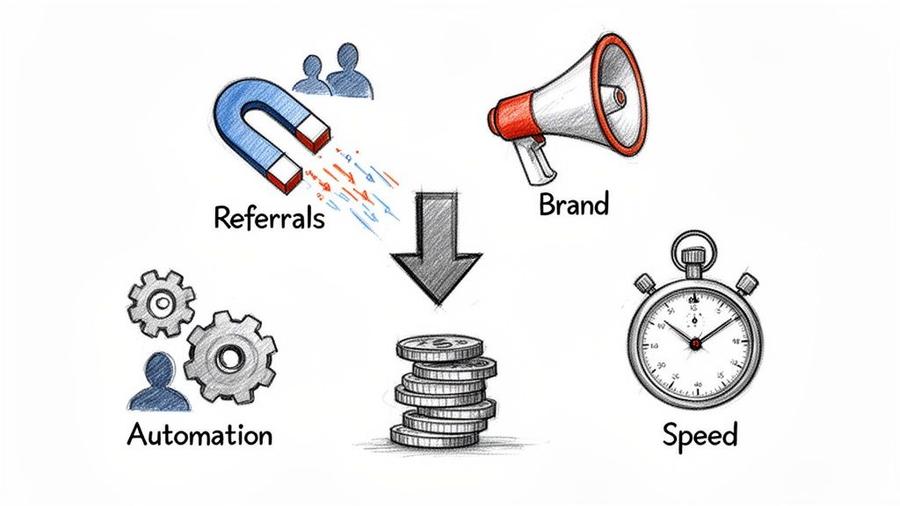
Knowing your cost per hire is a huge step forward. But the real goal is getting that number down without sacrificing the quality of your team. A lower CPH means more cash in your pocket, but it can't come at the cost of hiring the wrong people.
The best strategies are proactive, not reactive. They’re about building a system that attracts great talent efficiently and, more importantly, keeps them around for the long haul. This isn't about cutting corners; it's about being smarter with your resources. It’s about optimizing every step, from the first word of a job description to the final offer.
Build an Employee Referral Program That Actually Works
Let's be honest, your best employees are your most powerful recruiting tool. They already live and breathe your restaurant's culture and know exactly what it takes to succeed on your team. A solid employee referral program turns your staff into a high-quality, incredibly cost-effective sourcing channel.
The data doesn't lie: referred candidates are hired faster, perform better, and stay longer. To make your program a no-brainer, offer a bonus that actually motivates—cash is almost always king. Keep the process simple for your team to submit names and see where their referrals are in the process.
The real magic of a referral program is that it pre-screens for culture fit. Your team isn't just going to recommend anyone; they'll bring in people they genuinely want to work alongside, which is a massive boost for morale and retention.
Strengthen Your Employer Brand
Why should a talented line cook or server choose your restaurant over the one down the street? The answer is your employer brand. This is your reputation as a place to work, and a strong one attracts candidates organically, cutting down your reliance on expensive job ads.
Building your brand means showing people what makes your restaurant a great place to clock in. Highlight your culture, training opportunities, and any unique benefits on social media and your careers page. Your happiest employees are your best advertisers, so encourage them to share their positive experiences. A strong brand can lower your CPH by as much as 50% because the right candidates will start seeking you out.
Streamline Your Interview and Screening Process
Time is one of the biggest hidden costs baked into your cost per hire. A long, disorganized interview process doesn't just drain your managers' valuable time—it risks losing fantastic candidates to competitors who move faster.
Take a hard, honest look at your current process and find the bottlenecks.
- Use Phone Screens: A quick 15-minute phone call is a powerful tool. It can screen out candidates who aren't a fit, saving you hours of in-person interview time.
- Structure Your Interviews: Ask every candidate for a given role the same core set of questions. This makes it far easier to compare apples to apples and speeds up your decision-making.
- Leverage Technology: One of the smartest ways to manage and slash hiring costs is by adopting the right software. Finding the best ATS systems for small businesses can automate things like scheduling and candidate communication, giving your team back precious hours.
Below is a quick-glance table of actionable strategies you can implement right away. We've seen operators use these tactics to make a real dent in their hiring spend without compromising on the quality of their team.
Strategy How It Reduces Costs MAJC Tool to Use Employee Referrals Reduces advertising spend and agency fees; hires are often a better fit, lowering turnover. Coming Soon: Referral Tracking Employer Branding Attracts inbound candidates organically, cutting the need for paid job posts. MAJC Insights & Playbooks Process Automation Saves manager hours on manual tasks like scheduling and follow-ups. MAJC Scheduling & Messaging Retention Focus Hiring less often is the ultimate cost-saver; stops the expensive "revolving door." Employee Retention Playbook
Focusing on even one of these areas can have a ripple effect, improving not just your CPH but your overall operational health.
Focus on Retention to Stop the Cycle
At the end of the day, the most effective way to lower your CPH is to hire less often. High turnover is the engine that keeps your hiring costs spinning out of control. Every time a great employee walks out the door, you're not just losing a team member—you're kicking off another expensive hiring cycle.
Investing in your current team is the single best investment you can make in reducing future costs. This means providing clear paths for growth, offering competitive pay, and building a positive work culture where people feel valued. A robust onboarding program is critical here, as it can improve new hire retention by over 80%. By focusing on keeping the talent you already have, you directly attack the root cause of a high CPH. Learn more about how to improve employee retention with strategies that work.
Common Questions About Cost Per Hire
Once you start digging into your Cost Per Hire, a few questions always come up. Think of this as your field guide for applying this metric in the real world of your restaurant.
How Often Should I Calculate My Cost Per Hire?
When it comes to tracking CPH, consistency is everything. I recommend calculating it quarterly and annually to get a complete picture of your hiring health.
- Quarterly check-ins are great for spotting trends early. Did that new referral program move the needle? A quarterly calculation will tell you pretty quickly.
- An annual calculation gives you that solid, year-over-year benchmark. It’s how you measure real, long-term progress and see if your overall strategy is working.
If you want to get granular, calculate CPH separately for your Back of House and Front of House teams. It’s a great way to see where your hiring dollars are truly going and which department might need a different approach.
Does a Low CPH Automatically Mean My Hiring Is Efficient?
Not always. While efficiency is the goal, an unusually low cost per hire can be a red flag. It might mean you're cutting corners on critical steps like screening or training, which almost always leads to bad hires and higher turnover down the road.
The goal isn’t just to hire cheaply; it's to hire smartly. A healthy cost per hire should always be looked at alongside other key metrics, like your 90-day retention rate and overall team performance. That’s how you know you’re bringing on quality people who stick around.
What’s the Biggest Mistake Restaurants Make When Calculating CPH?
Hands down, the single biggest mistake is forgetting to include the cost of internal time. Every hour a manager spends writing job ads, sifting through résumés, and conducting interviews is a real, significant expense. It’s also the one that gets overlooked most often.
Other common slip-ups include not tracking employee referral bonuses or just being inconsistent with how expenses are logged from one hire to the next. The only way to get a number you can trust is to create a simple, standardized tracking process and stick to it.
Should I Exclude Bad Hires from My CPH Calculation?
Absolutely not. It’s tempting to sweep those costly mistakes under the rug, but you have to include hires who don't work out. In fact, a high rate of early turnover is one of the clearest signals you can get that your hiring process is broken.
Including these costs is essential because it shows the true financial gut punch of a bad hire. That number becomes a powerful, data-backed reason to get your screening, interviewing, and onboarding right the first time.
Ready to stop guessing and start making data-driven hiring decisions? The tools and systems from MAJC are designed by restaurant operators to help you attract, hire, and retain top talent more efficiently. Discover how our playbooks and community can lower your costs and build a stronger team.